


A senior executive is visiting the office for the first time in a year. Everyone knows. Desks are cleared, slides are polished, and when she walks in, people line up to say hello and tell her how much they enjoyed her last town hall. Behind them, a junior colleague who stayed late to set up the room and fix the projector is quietly packing away the spare cables. Nobody mentions it. Nobody has noticed.
It isn't malice. It's just where attention naturally goes, the same pull that makes people laugh a little too hard at a senior person's joke.
When the Star Walks In
There's an old sitcom scene that plays this for laughs. In an episode of The Fresh Prince of Bel-Air, a famous guest drops by the family's house, and the household falls over itself to impress him. Carlton is so overwhelmed he ends up on the floor. The visitor gets all the attention in the room, and the people who live there more or less disappear into the background.
It's exaggerated, but not by much. Most workplaces have a version of it every time someone important arrives. Charm, in those moments, tends to flow upward.
In many workplaces and cultures, deference to seniority is expected, and often sensible. The point isn't to stop showing respect upward. It's to make sure it doesn't stop there.
Why Attention Follows Status
Part of this seems to be built into how we see people. Research on face memory has found that people tend to remember faces they believe belong to high-status individuals better than faces they believe belong to lower-status ones (Ratcliff et al., 2011).
That has a quiet consequence at work. Recognizing people's strengths comes easily when the person is senior, visible, or already celebrated. Their good ideas are noticed, repeated, and credited. The same quality in someone junior or quiet can go unremarked for months, simply because nobody was looking in that direction.
This matters more than it seems. People who feel their strengths are invisible tend, over time, to stop offering them. And leaders who only notice what high-status people do end up with a narrow and slightly distorted picture of their own team.
It's worth checking your own pattern. Think back over the last month: whose ideas did you repeat in meetings, and whose did you forget you'd heard?
Noticing Strengths Below the Spotlight
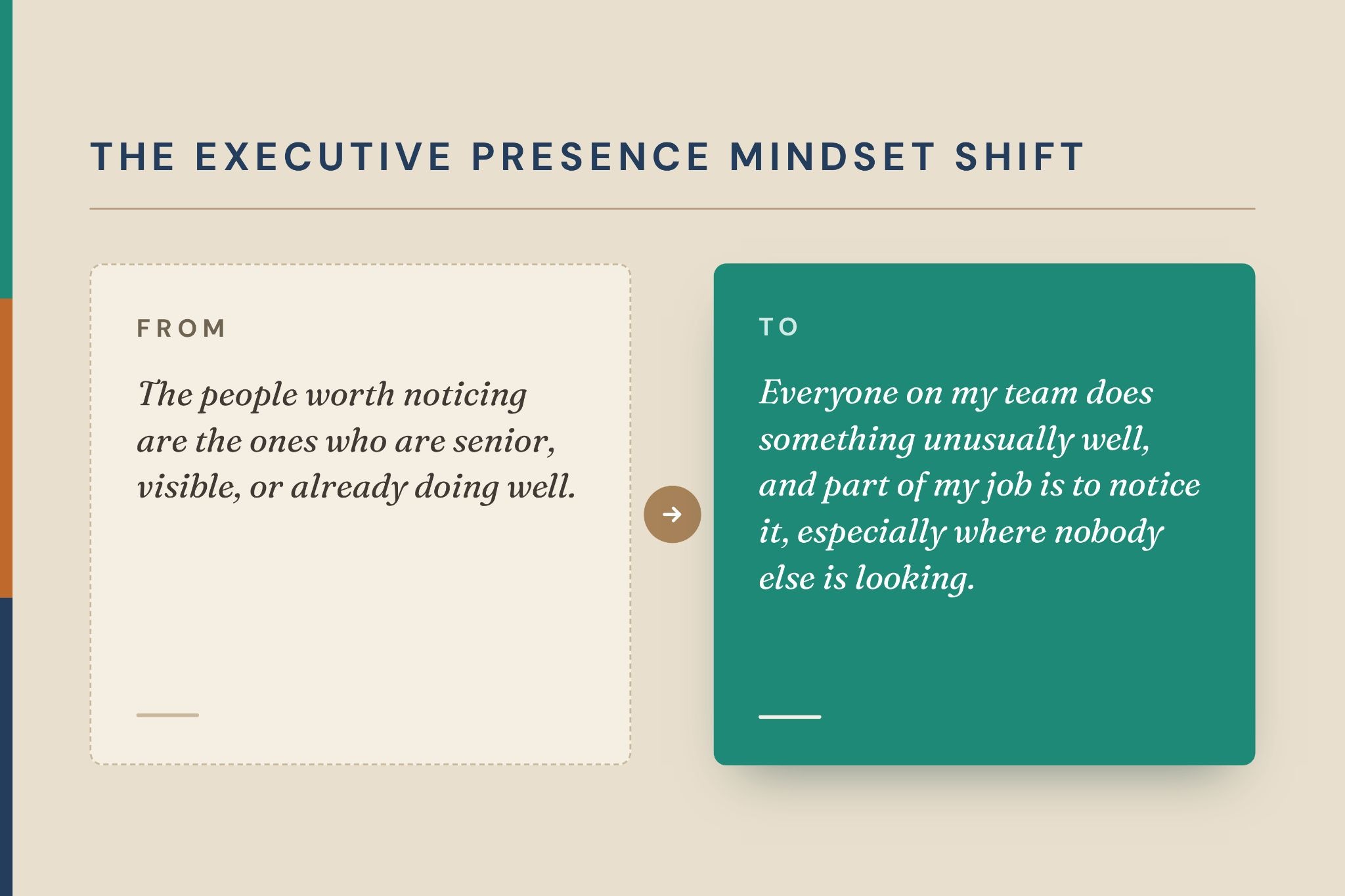
The fix isn't to ignore senior people. It's to spread attention more deliberately. In practice, that means looking for what each person does unusually well, especially the people who don't make it easy for you by being loud about it.
Often it's small. The analyst who always spots the flaw in a forecast before anyone else. The coordinator who knows exactly who to call when a supplier goes quiet. The new hire who explains technical problems in a way clients actually understand. None of these will appear on a slide. All of them are strengths.
One way in is simply to ask. "Who do you go to when you're stuck on a client problem?" often surfaces strengths that never reach a manager's desk.
Naming them matters as much as noticing them. Specific praise at work that points to a particular strength, "You're the one who always catches the forecasting errors," tells someone their distinctive contribution has been seen. It's also often the first step in helping employees reach their potential, because people rarely build on strengths nobody has pointed out to them.
It shows up in decisions, too. When a new project needs a lead, the same few names tend to come up. Asking "Are there any other options we haven't considered?" and meaning it is one of the simplest ways to bring quieter strengths into view.
A lot of executive presence coaching focuses on how leaders come across to those above them. Just as telling is how they treat the people who can do nothing for them. At Coach Vikram & Company, we would say that charm is most visible not in how you greet the most important person in the room, but in whether anyone else leaves feeling noticed.