



For years, you led a team that sat together. You knew who was struggling by the look on their face at the coffee machine. Problems surfaced in corridors before they reached meetings. Then the role grew. Now your team sits in four countries, and the weekly call is the main place you see them. You ask whether anyone has questions. There is a pause, a few polite answers, and the call ends early.
Many leaders who were excellent in a close-knit, co-located setting find this shift unexpectedly hard. The team has not become less capable or less committed. It has lost most of the channels through which it used to talk to you.
Distance has real effects. A study of teams in a large multinational company found that geographically distributed teams reported more task and interpersonal conflict than teams working in the same place, and that spontaneous, informal communication was linked to a stronger shared identity and more shared context, which reduced that effect (Hinds and Mortensen, 2005). The corridor conversations were doing important work. Learning how to get your team to speak up in meetings across time zones means rebuilding that work through three deliberate moves.
Move 1: Replace the Open Invitation With a Named Question
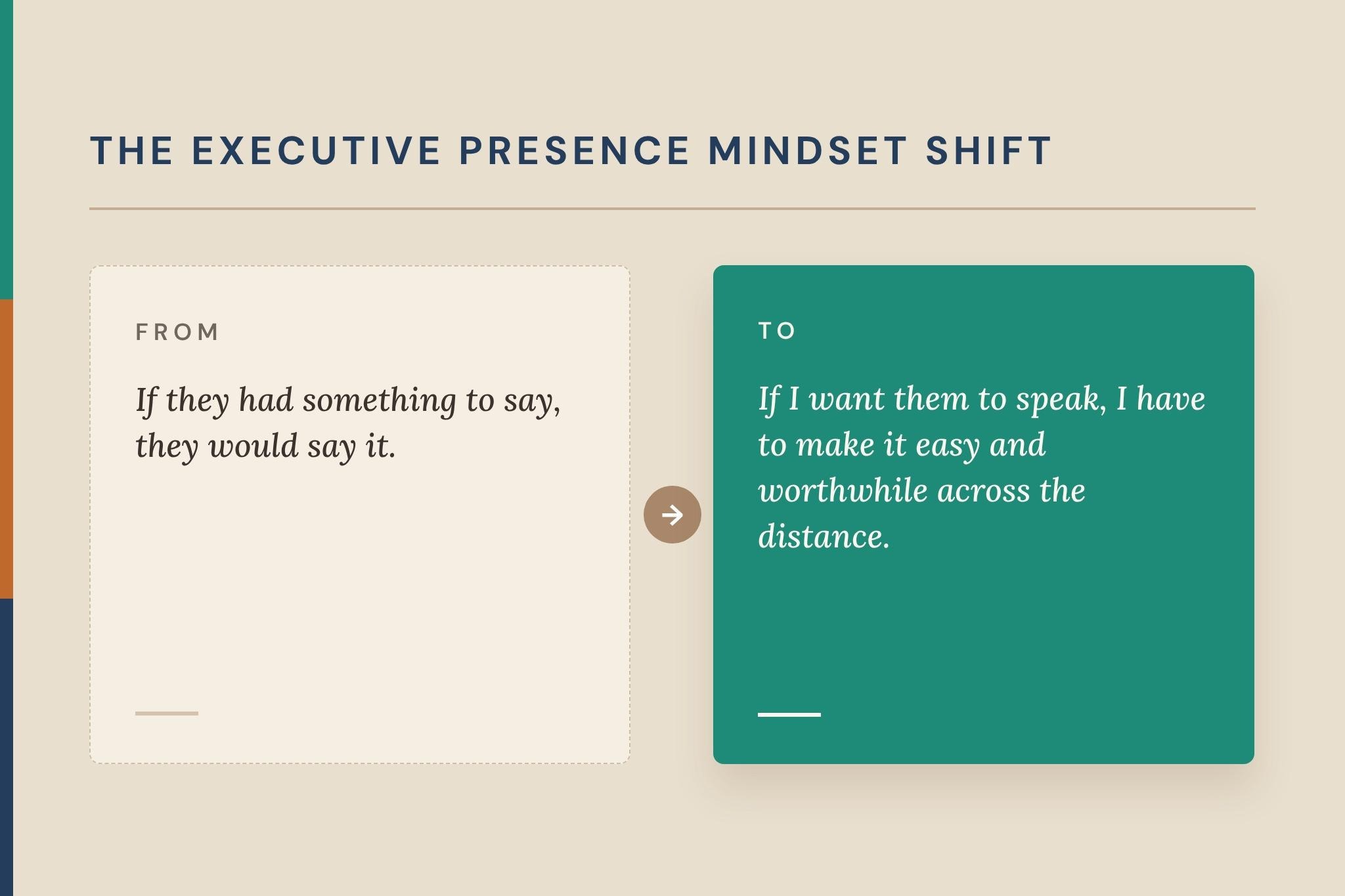
“Any questions?” is one of the least effective questions in remote leadership. It asks everyone and no one, and silence is the easiest answer. Specific questions to specific people work far better. “Ana, you’ve seen this rollout in your market. What would worry you about doing it here?” That gives someone permission and a reason to speak. It also helps to explain why you are asking. “I want to hear from the markets that have tried this before we commit” tells people their experience is the reason for the question, not a formality.
Getting quiet team members to contribute often needs a second route in. Some people find it far easier to write than to speak on a call, especially in a second language. Inviting comments in the chat, or a short written view before the meeting, widens who takes part.
Move 2: Ask Before You Decide, Not After
If the team only hears the plan once it is settled, they learn that speaking up is not really expected. Share the question before the answer. When a decision is genuinely open, say so, and ask whether there are any other options worth considering.
Time zones matter here too. A colleague joining at the end of a long day, or very early in the morning, is rarely at their most forthcoming. Rotating meeting times, so the same people do not always carry the inconvenience, signals that everyone’s view is wanted. When people do speak up, what happens next matters as much as the invitation. If a concern raised on a call quietly disappears, the team notices. A short note afterward saying what changed because of their input makes the next contribution far more likely.
Move 3: Rebuild the Corridor Outside the Meeting
The biggest change happens between meetings. Short, regular one-to-one calls rebuild some of what the corridor used to provide. Questions to ask in one-to-ones can be simple: what is taking most of your energy this week, what would make your work easier, what am I not seeing from here?
This does not mean filling every evening with calls. Leaders of distributed teams often respond to distance by adding meetings at odd hours, and over time that can quietly lead to leadership burnout, which helps nobody on either side of the screen. A few well-chosen conversations do more than many rushed ones. Over time, the meeting itself gets easier, because it is no longer the only place where anything gets said.
At Coach Vikram & Company, we would say that a quiet remote team is rarely a disengaged one. More often, it is a team that has not yet been invited in the right way. It is a common theme in executive presence coaching for leaders whose teams have grown across borders faster than their ways of leading.
3 WAYS TO PRACTICE THIS WEEK
1. Replace “any questions?” with a named question
In your next team call, ask one person a specific question linked to their experience.
Rotate who you ask, so everyone learns their view is expected.
2. Ask before you decide
Before your next decision affecting the team, share the question rather than the answer and ask for views.
It is one of the simplest ways of how to make meetings more engaging: give people something real to influence.
3. Hold one short one-to-one each week
Choose one team member each week for a fifteen-minute call with no agenda beyond how things are going.
Over a month, it rebuilds some of what the corridor used to provide.
KEY TAKEAWAYS
- REFERENCES
RELATED QUESTIONS