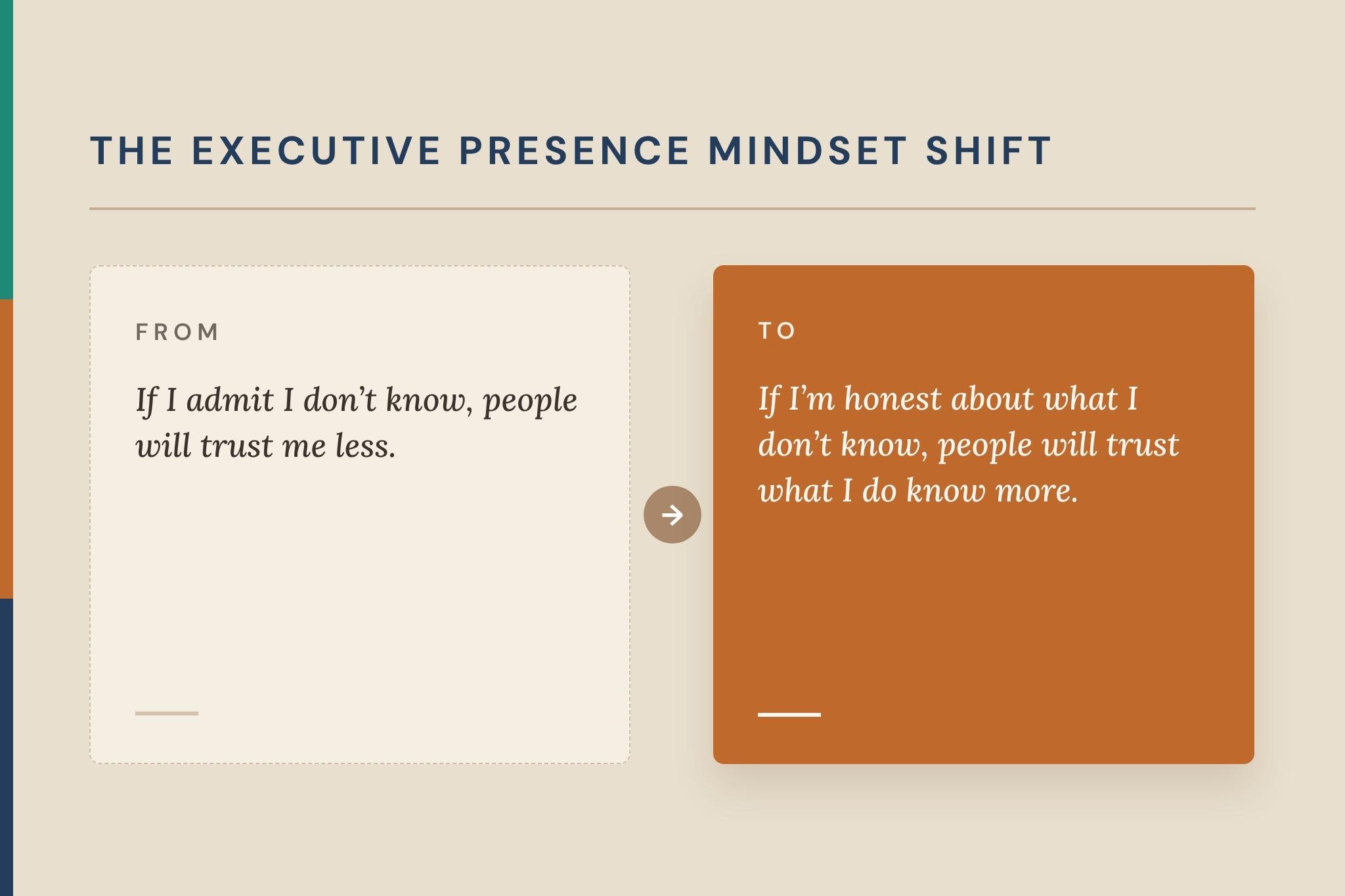

Someone in a meeting asks you about a part of the business you have only just taken on. You do not know the answer. There is a familiar pull to say something that sounds like one: a confident generalization, a reference to what usually happens, a promise to circle back that is really a way of not saying “I don’t know.”
For many leaders, especially those who built their reputation on being the expert, those three words feel risky. Expertise is what got them promoted. Not knowing feels like it undermines the very thing people rely on them for.
Yet the higher the role, the more often a leader will be out of their depth on something: a bigger remit, a new region, an unfamiliar function. Humble leadership is not a trait reserved for the naturally modest. It is a practical response to the fact that nobody at that level can know everything.
Why Not Knowing Feels Like a Threat
The fear makes sense. In expert roles, being right is the job, and being wrong has consequences. Over the years, that can harden into a rule: never be seen without an answer. Leaders following that rule tend to over-prepare, steer away from unfamiliar topics, and quietly take on work themselves rather than ask someone who knows more.
The cost is easy to miss. If the leader always has the answer, the team learns that its own knowledge is not needed. People stop offering what they know. Problems surface late, because admitting a gap has become something nobody on the team does.
There is a quieter cost to the leader as well. Carrying the expectation of always knowing is tiring, and it turns every unfamiliar question into a test. Leaders who let go of that expectation often describe a kind of relief. They can think out loud, ask for help, and spend their energy on decisions rather than on protecting an image.
What Humility Actually Looks Like
Saying I don’t know at work is only part of it, and how you say it matters. “I don’t know” followed by silence can sound like a shrug. “I don’t know yet. Our operations lead has looked at this more closely, so let’s hear from her” sounds like a leader who knows how to get answers.
Admitting mistakes as a leader works the same way. A plain “I got that wrong, and here is what I’m changing” tends to steady people. A long, anxious apology or a defensive explanation does the opposite.
There is research suggesting this matters. In a series of studies, leaders’ visible humility was linked to more engaged employees, through teams that were more oriented toward learning, and to better retention, through higher job satisfaction (Owens, Johnson and Mitchell, 2013).
Humility is not the same as low confidence. A humble leader still makes decisions, still holds a view, still says no. What changes is that they are open about where their knowledge ends and genuinely interested in what others know.
Learning in Front of Others
The most visible form of humility is learning from your team in front of them. Ask a junior colleague to explain something you don’t understand. Ask whether there are any other options you haven’t considered, and mean it. When someone corrects you, thank them and change course.
For leaders whose work spans countries and cultures, this matters even more. Local teams usually understand their markets, customers, and regulators better than anyone at a regional level can. A leader who asks them to teach, rather than simply report, tends to hear better information and more honest warnings.
These moments often happen in front of senior people, which is exactly when the urge to bluff is strongest. Steadying yourself first helps, and knowing how to stay calm under pressure makes an honest “I don’t know” much easier to say.
At Coach Vikram & Company, we would say that the leaders people trust most are rarely the ones who seem to know everything. They are the ones who are honest about what they don’t. That distinction comes up often in executive presence coaching with experienced specialists stepping into broader roles.