

An opportunity comes up to lead something new: a pilot in an unfamiliar market, a partnership nobody in the organization has tried before. You are an obvious candidate. You are also, quietly, the person most likely to talk yourself out of it. The plan could fail. The market could be wrong. And in fifteen years, you have rarely been associated with anything that did not work.
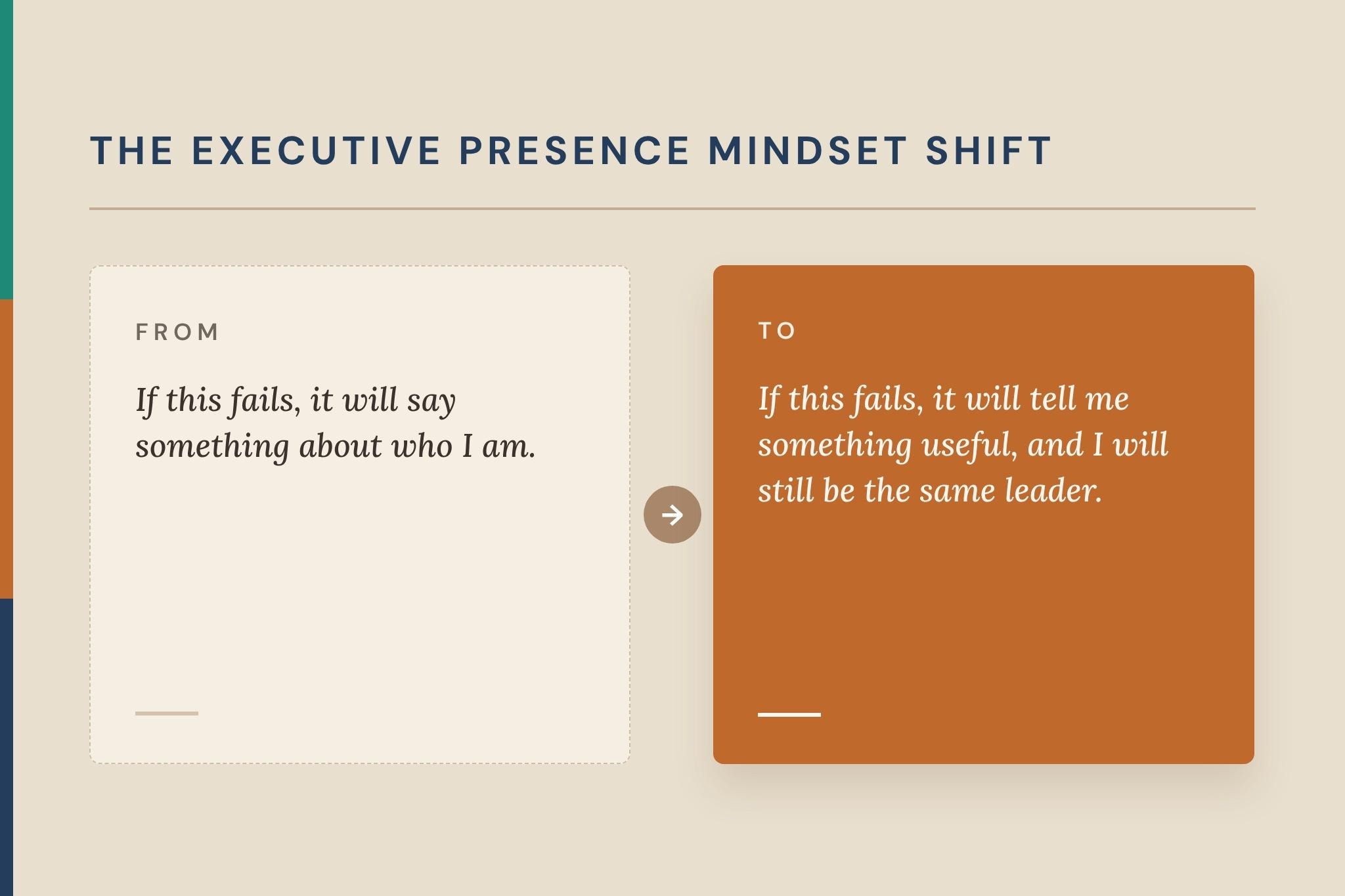
That record is genuinely impressive. It is also, sometimes, a trap. Leaders who have built their reputation on precision and reliability can come to treat a clean record as part of who they are. Every new risk then feels less like a business decision and more like a threat to their identity. So they choose the projects they know they can deliver, refine proposals rather than submit them, and stay just inside the edge of their competence.
Fear of making mistakes at work rarely announces itself. It shows up as caution, extra analysis, and an unusually tidy track record. Learning how to overcome fear of failure at work is less about bravery than about treating yourself kindly enough to try. Three questions help.
Question 1: What Exactly Am I Afraid of Losing?
Fear of failure is usually vague, which is what gives it power. Naming it often shrinks it. Is the fear about the money, the project, or the people affected? Or is it about how you will see yourself, and how others will see you, if it does not work? Once named, the fear can be weighed against the cost of not trying, which is usually far less visible but often larger.
For many high achievers, the honest answer is the second one. The fear is not really about the outcome. It is about what a visible failure would say about them. That is worth noticing, because a worth that depends on never failing is a worth that can never fully relax.
Research on self-compassion suggests why this matters. In studies of students, those who treated themselves with more kindness showed less fear of failure and were more oriented toward learning than toward proving themselves (Neff, Hsieh and Dejitterat, 2005). Accepting yourself regardless of the outcome is not complacency. It is what makes trying possible.
Question 2: What Is the Smallest Version of This Risk?
Fear tends to imagine the largest possible failure. In practice, most risks can be broken down. Instead of committing to the full market entry, could you run a small pilot? Instead of announcing a new approach, could you test it with one team? A small test also gives you real information, which is far more useful than an imagined disaster.
Asking whether there are any other options between doing nothing and betting everything often reveals a version of the risk that is genuinely affordable. Small experiments also build a different kind of record, one of learning from failure as a leader rather than avoiding it.
Question 3: What Will I Do If It Goes Wrong?
Much of the dread comes from not knowing how you would cope. Deciding in advance takes some of that away. If the pilot fails, what will you say, to whom, and what will you try next? Written down, the answer usually looks far more manageable than the fear suggested. Often it turns out to be something you have handled before, in another form, and recovered from perfectly well.
It helps to decide, too, how you will treat yourself. A leader who meets a failed experiment with curiosity rather than self-punishment shows the team that intelligent risks are welcome. One who visibly berates themselves teaches everyone to play safe. Setbacks are part of any ambitious path, and staying positive through setbacks is a skill worth building alongside the courage to take them.
At Coach Vikram & Company, we would say that the leaders who grow fastest are rarely the ones with the cleanest records. They are the ones whose sense of their own worth can survive a failure. It is a recurring theme in executive presence coaching with high achievers stepping into roles that reward experimentation more than precision.