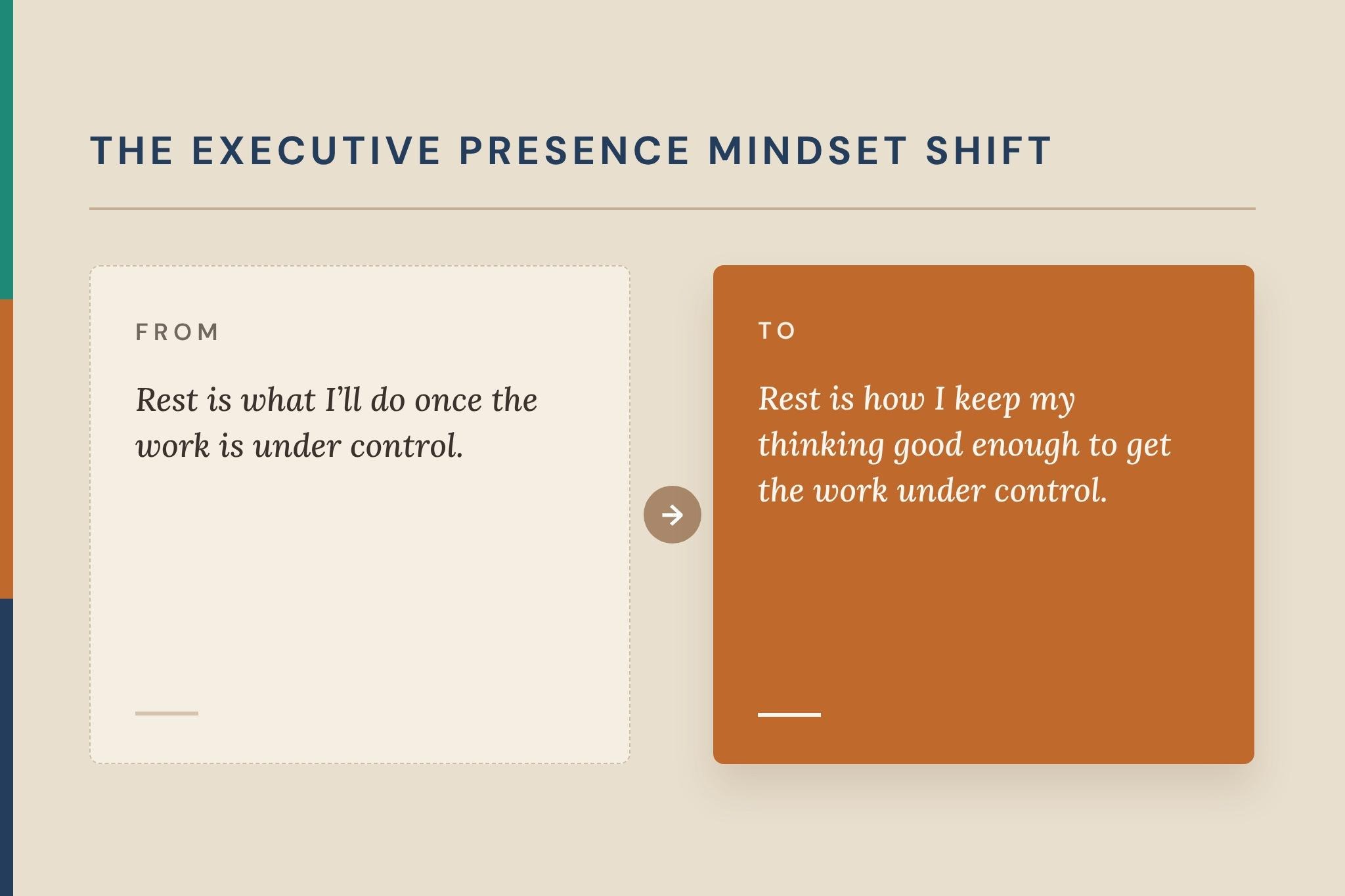

You are the first online and the last to log off. Every escalation finds its way to you, partly because you are good at resolving them and partly because you have never quite stopped taking them. Evenings are for catching up. Weekends are for the thinking you could not do during the week. It works, mostly. You are tired, but you are delivering.
Many leaders who reach senior roles got there by working harder than anyone around them. The difficulty is that the habit tends to outlast the role it suited. At a senior level, the work is less about getting more done and more about thinking clearly, and that is exactly what exhaustion erodes first. Tired leaders react rather than plan, and swing between short-term firefighting and occasional bursts of long-term thinking without quite connecting the two. From the outside, it can look like commitment. From the inside, it often feels like never quite getting to the work that matters most.
Recovery matters more than it seems. A study that tracked employees day by day found that on days after they felt well recovered during their leisure time, people were more engaged at work and showed more initiative and more willingness to learn (Sonnentag, 2003). Knowing how to avoid burnout as a leader is not about caring less. It is about three habits that protect the capacity your role depends on.
Habit 1: Build Small Breaks Into the Working Day
Rest and recovery sound like things that happen outside work. For leaders, they work better inside it. A short pause between demanding meetings. A walk instead of another call. Fifteen minutes with the door closed and no screen. If even that feels impossible, start smaller: five minutes between two calls, used to stand up and look out of a window rather than at another screen.
None of these are dramatic. Their value comes from repetition, because small, regular recovery protects the mind far better than an occasional long break taken once exhaustion has already set in. It also matters for others, because teams tend to copy the hours and habits of the leader at the top.
Habit 2: End the Day Properly
Switching off in the evening is often the hardest part. If the mind keeps returning to work, it is not recovering, even if the laptop is closed. A clear end point helps: a genuine stop, rather than a slow fade into email.
Writing down tomorrow’s first three tasks before you stop can make a real difference, because it tells your mind nothing will be forgotten. After that, something absorbing that has nothing to do with work does more for recovery than scrolling through messages. It also helps to protect at least part of the weekend from work entirely. The thinking you were saving for Saturday is often better done on Monday morning by a rested mind.
Habit 3: Question What Genuinely Needs You
Many escalations reach senior leaders out of habit rather than necessity. Before taking one on, ask whether there are any other options: someone closer to the problem, a decision that can wait, a rule that would let others handle it next time. Each one passed on frees attention for the work only you can do. This is not about doing less. It is about making sure your attention goes to the decisions that are genuinely yours.
Leading on empty can start to feel normal, especially for people who have always coped. Watch for the small signs: irritation at minor things, decisions postponed, less patience with people you usually enjoy. People close to you often see them first. Pressure and tiredness also feed each other, and knowing how to stay calm under pressure is easier when you are not already running on reserves.
At Coach Vikram & Company, we would say that a leader’s energy is not a private matter. It shapes the mood, the pace, and the quality of decisions around them. It is a recurring theme in executive presence coaching with high performers who have never learned to stop.