



A few minutes before a big presentation, a manager stands in the corridor, hunched over her phone, rereading her notes for the fourth time. Her shoulders are curled in and her chin is down. By the time she walks into the room, she feels smaller than when she started, and she isn't sure why.
Most people have been in that corridor. And most of the advice on how to build self-confidence at work tells them to fix it from the inside: think positive thoughts, remember past wins, believe in yourself. The body gets left out.
What a Famous Talk Got Right, and What It Didn't
In a well-known TED talk, social psychologist Amy Cuddy asked whether our nonverbal behavior shapes how we think and feel about ourselves, not just how others see us. Her answer was that it might. She described research suggesting that holding an open, expansive posture for a couple of minutes could make people feel more powerful, and even change their hormone levels. Her advice was not to fake it until you make it, but to fake it until you become it.
It was an appealing idea, and it partly held up. A larger follow-up study found that expansive poses made people report feeling more powerful, but found no effect on their hormones or on the risks they were willing to take (Ranehill et al., 2015).
So the honest version is more modest. How you hold yourself before a stressful moment may help you feel a little more confident. It won't change your chemistry, and it won't do the work for you. That's still worth something. In practice, it might mean standing up straight in the corridor instead of curling over your phone, or sitting back in your chair rather than perching on the edge of it. It just isn't the whole answer.
Where Self-Belief Actually Comes From
Feeling confident and being confident aren't quite the same thing. A posture can nudge the first. The second tends to come from evidence: the accumulating record of times you did something difficult and it turned out fine.
That's why confidence as a new manager is so often fragile. There's no record yet. Every new situation feels like a test, and self-doubt as a leader fills the gap where experience will eventually sit. The fix isn't to argue with the doubt. It's to keep adding to the record, one difficult thing at a time.
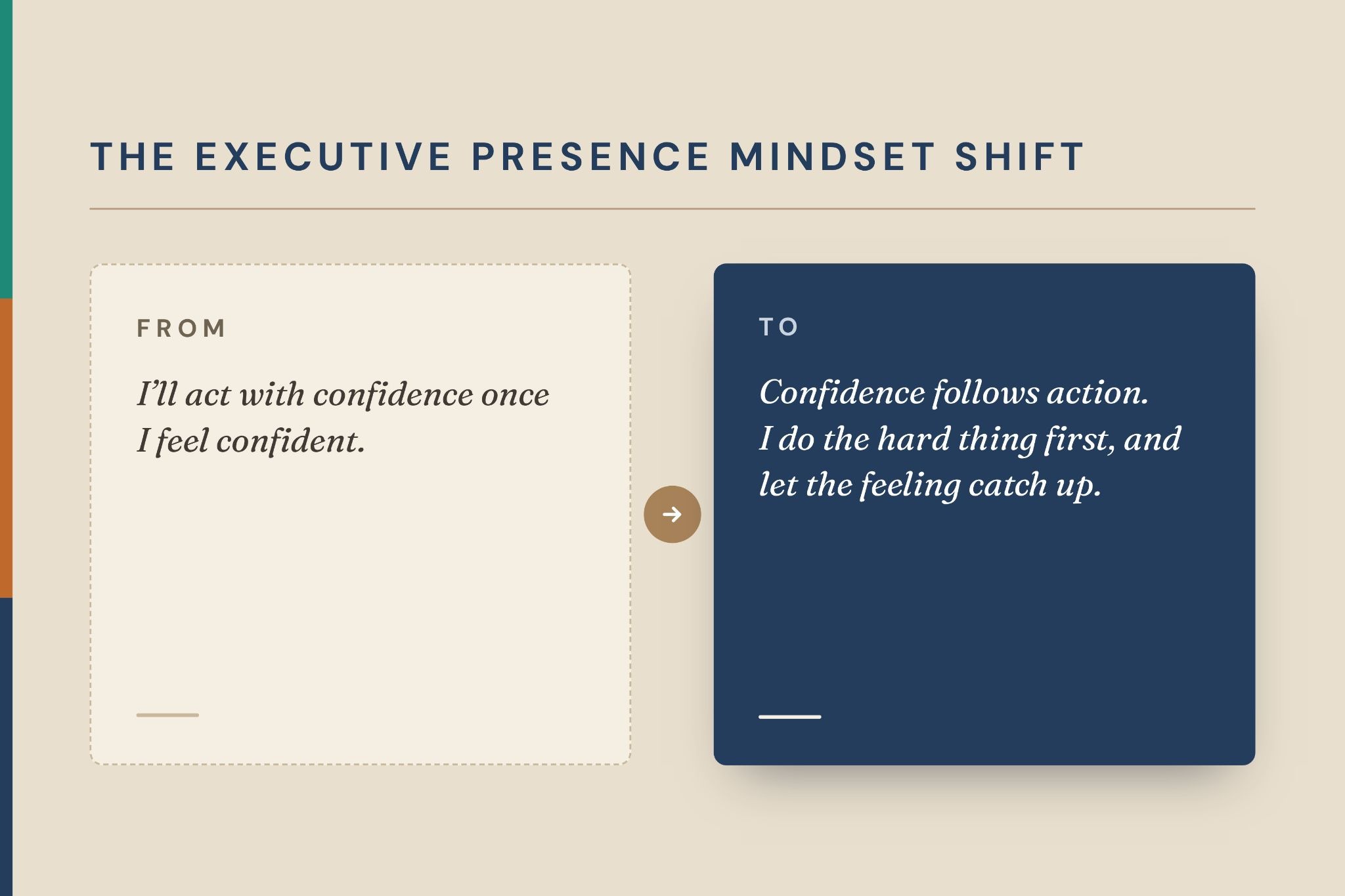
When the doubt is loud, it's worth asking whether waiting until you feel ready is really the only choice, or whether there are any other options. Usually there is one: act first, and let the feeling catch up.
Confidence also looks different across people and cultures. Some of the most trusted leaders are quietly sure of themselves rather than visibly bold. The aim isn't to look confident. It's to stop letting doubt make your decisions for you.
Showing Up Before You Feel Ready
Read generously, "fake it till you become it" isn't about pretending. It's about continuing to show up in situations that feel slightly beyond you, until they stop feeling that way. Nobody feels ready for their first board presentation. People who become comfortable with them are usually just people who have done several.
Self-doubt has another cost that's easy to miss. A mind busy checking how you're coming across has little attention left for anyone else. That's one reason being present in meetings can feel so hard on the days your confidence is low: the commentary in your own head is louder than the room.
It helps, too, to notice the habit of reopening decisions you've already made. How to stop second-guessing yourself is less about certainty than about deciding when a decision is finished. Once it is, revisiting it every evening doesn't add information. It just subtracts confidence.
A lot of executive presence coaching focuses on how confidence looks from the outside. The more durable part is what builds it underneath. At Coach Vikram & Company, we would say self-belief grows less from feeling sure than from a growing record of having been unsure and doing it anyway.