

.png)
Ten minutes before a presentation, most people are running a commentary nobody else can hear. Don't rush the numbers. They're going to ask about the delay. You always lose the thread on slide six. None of it is said out loud, but it shows anyway — in a tight voice, or a first sentence that comes out too fast.
Plenty of capable leaders talk to themselves in a way they'd never dream of talking to a colleague. They'd be appalled to hear anyone else say it.
The Voice Nobody Else Hears
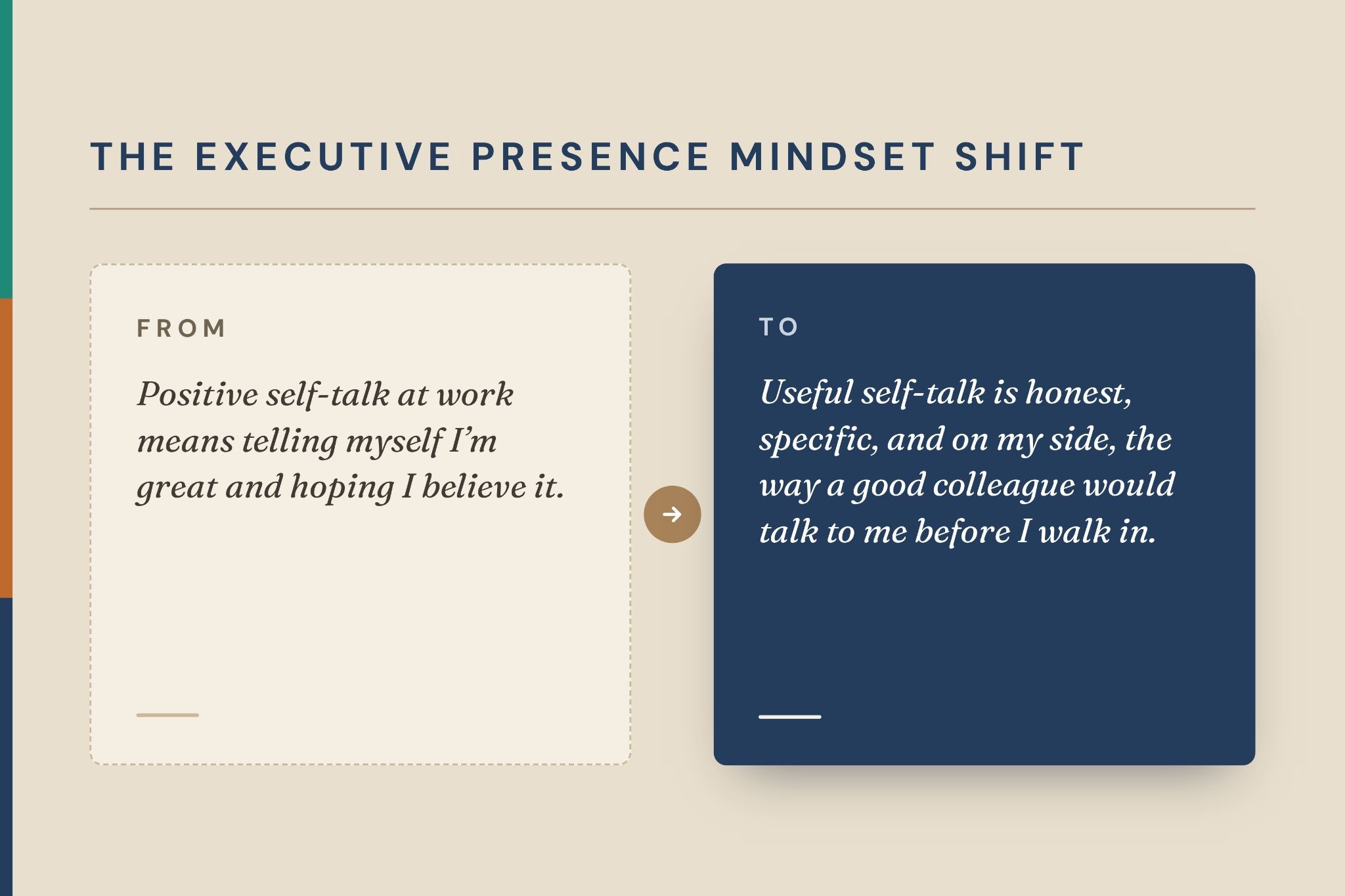
Positive self-talk at work has a faintly embarrassing reputation — mirror slogans, forced cheerfulness, the whole genre. But everyone already talks to themselves, all day, without pausing to decide to. The only real question is what that voice is saying, and whether it's doing you any good.
Most of it slips by unnoticed. Nobody sits down and chooses to think "I'm going to make a mess of this" — it just arrives, usually in the same words every time, and you take it as a fact rather than a sentence you happen to be telling yourself. Which is the catch: how to change negative self-talk starts with actually hearing it.
It helps to know your usual lines. Some people predict disaster; others replay an old mistake on a loop. Once you recognize yours, you can start to reframe negative thoughts as they come. That doesn't mean arguing with them. It means asking whether you'd say the same thing to someone on your team.
What a Pendulum Shows
There's a clip of Deepak Chopra with Oprah Winfrey in which a small pendulum, held as still as possible, starts to swing once the person holding it simply imagines it moving. When the idea changes, the direction of the swing changes too. Chopra's point is that every cell in your body is eavesdropping on your inner dialogue.
That goes further than the evidence does, and the demonstration doesn't need it. Psychologists call what's happening the ideomotor effect: tiny, unconscious muscle movements that follow what you're thinking about. Nothing mystical moves the pendulum. Your hand does, without asking you first.
That is the useful part, and it's more than enough. If an idea can move your fingers without your permission, it's reasonable to assume that "you're going to blow this" does something to your shoulders and your voice on the way into a meeting.
Affirmations That Survive Contact with Reality
The trouble with many affirmations for leaders is that they're too big to believe. "I am a confident, inspiring leader" bounces straight off a mind that's busy remembering last week's awkward meeting. Generic praise from yourself works about as well as generic praise from anyone else.
What tends to hold up is evidence. "You walked the board through worse numbers than this in March" is harder to argue with, because it happened. It reminds you of something you've already done rather than asking you to believe something you don't.
The wording matters too. Across a series of studies, people who spoke to themselves by name or as "you" before a stressful speech — rather than "I" — held up better, and judges rated their speeches more favorably (Kross et al., 2014). That small bit of distance makes it easier to be level-headed and kind at the same time, the way you manage to be with a friend but rarely with yourself.
So if you're wondering what to say to yourself before a presentation, one true sentence and your own name will usually do more than a whole paragraph of encouragement.
Self-talk also quietly decides what you think you're allowed to do. "I'll just push through and rest later" sounds like resilience, and it's exactly how people end up leading on empty. Under pressure, the inner voice shrinks everything down to a single option. Just asking yourself whether there are any other options can open the situation back up.
A lot of executive presence coaching ends up circling back to this one conversation — the one leaders have with themselves just before they walk into a room — because everyone else sees its effects long before they hear a word. At Coach Vikram & Company, we'd put it plainly: the most useful self-talk doesn't sound like a pep talk. It sounds like a trusted colleague reminding you of what you've already shown you can do.