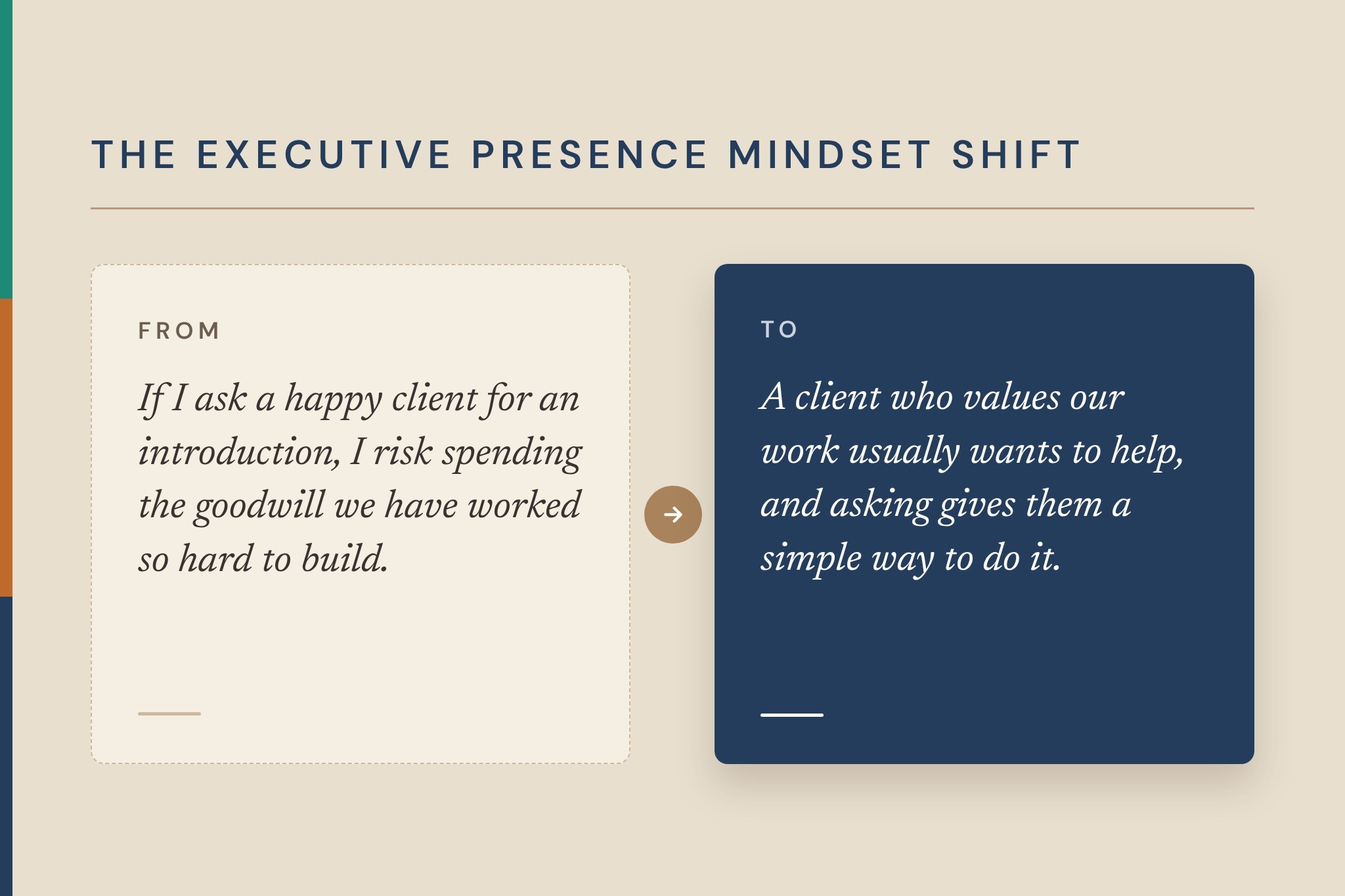

Most delivery leaders can think of a client who is genuinely happy with their work, who praises the team in steering committees and would probably describe them warmly to a colleague in another business unit. Yet the request for an introduction never quite gets made, because each time the moment arrives, a quiet voice suggests that the client will say no, or that asking will change how they see you.
That voice deserves a closer look, because it is not reporting facts but making a prediction, and it is usually a pessimistic one. It turns a reasonable professional request into a test of the relationship, and it leaves new business on the table that your delivery has already earned.
Learning how to ask a client for an introduction therefore starts with your own inner dialogue rather than with a script, and the evidence is firmly on your side. In a series of studies, people underestimated by as much as half how many others would agree to a direct request for help, largely because they overlooked how awkward it feels to say no (Flynn and Lake, 2008).
Question the Story Before You Ask
Before you decide that a client will refuse, write down the reasons you believe it, and then set them against what you actually know about this person and how they have treated your team. Most of the time the story falls apart quickly, because a client who has praised your work in public has already shown that they want you to succeed. It can also help to ask yourself how you would respond if this client asked you for a similar favor, because most of us would be glad to help someone whose work we admired.
This is where an optimistic mindset with clients makes a practical difference, since it replaces an assumed refusal with a fair estimate of how the client is likely to respond. You are not pretending that every request will succeed, only refusing to let an untested prediction make the decision for you.
Ask When the Value Is Fresh
The best moment to ask is shortly after the client has seen the value of your work for themselves, such as a successful go-live, a problem solved ahead of schedule, or a steering committee that went well. At those moments your request feels like a natural extension of a good conversation rather than an interruption, whereas the same request made out of the blue can easily feel like a sales call.
It also helps to make the request specific, naming the business unit or colleague you would like to meet and explaining briefly why your team might be useful to them. Asking in this specific way shows that you have thought about their organization, and it makes it far easier for them to picture saying yes.
Make It Easy to Say Yes, or No
Offer to write a short note that the client can forward, so that the introduction costs them a minute rather than an afternoon, and make it clear that you will understand completely if the timing is not right. You might also ask whether there are any other options they would suggest, such as a colleague who would be a better first contact, which keeps the conversation open even if the answer to your original request is no. A refusal handled gracefully often leads to a better introduction later, because the client remembers how easy you made it for them.
Whatever the outcome, thank the client sincerely, because the way you handle the answer shapes how they feel about being asked again. When an introduction does come through, remember that your team’s delivery earned it, and take the time to show appreciation to employees whose work made the client so willing to help.
At Coach Vikram & Company, we would say that your delivery experience is your advantage here, because the strongest introduction any client can make is one based on work they have watched you deliver. Leaders who come to executive presence coaching often find that the hardest part of asking was never the client’s answer but the conversation they were having with themselves beforehand.