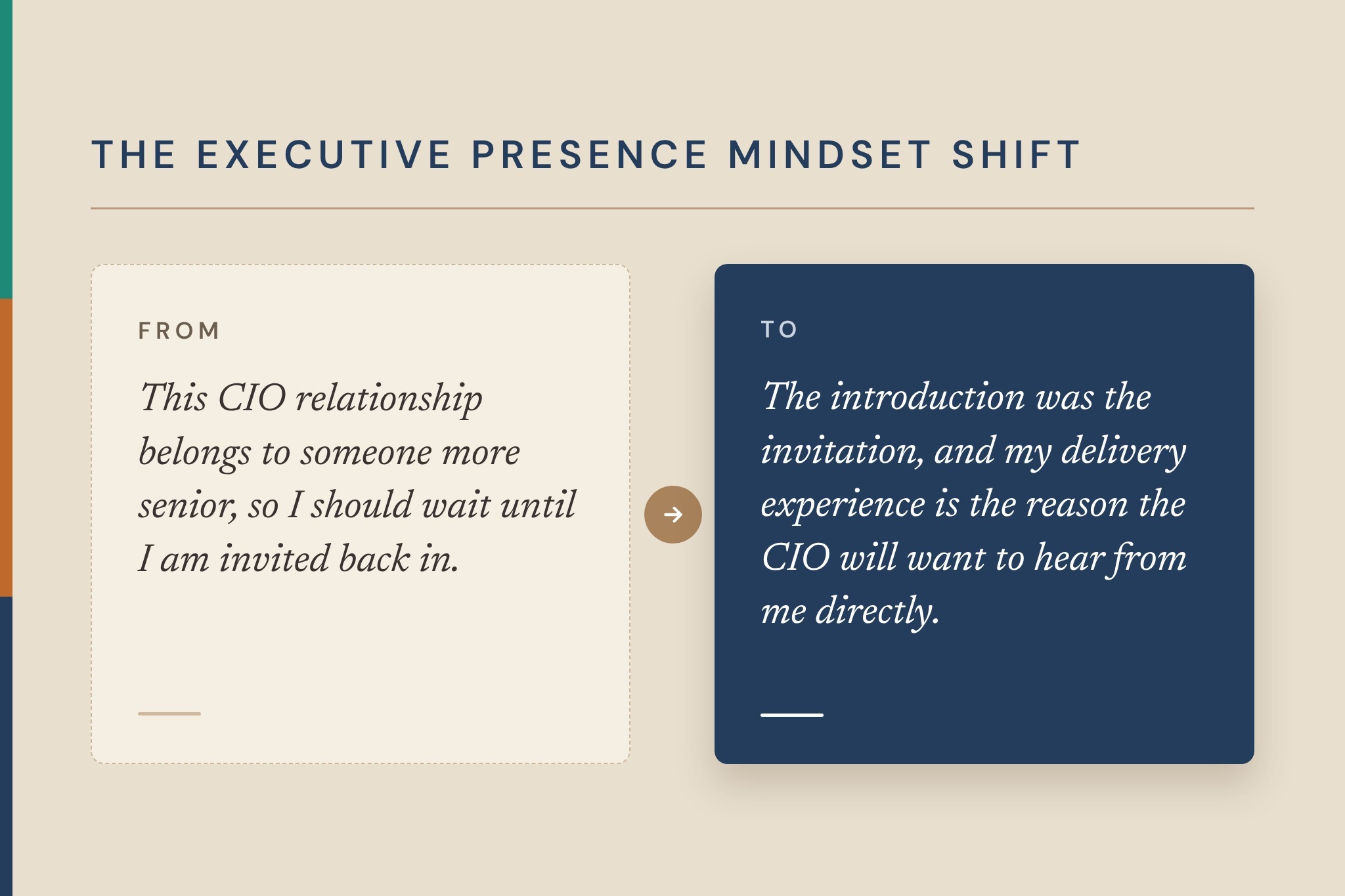


Your client partner has done the hard part, because they have introduced you to the CIO, spoken well of your work, and suggested that the two of you stay in touch. A week later the CIO’s name is still sitting in your notes, and every time you think about reaching out, a quiet voice suggests that it might be better to wait until the partner sets up the next meeting.
That voice is persuasive because it sounds like good manners, as though calling the CIO directly would mean stepping on someone else’s relationship or presuming a seniority you have not yet earned. Yet the longer you wait, the more the introduction fades into a pleasant memory, and the CIO goes back to hearing about your work only through the person who introduced you.
Learning how to be confident with senior clients is less about feeling bolder and much more about seeing the situation accurately, because senior people usually think better of a conversation than the other person assumes. Research on first conversations found that people consistently underestimate how much their conversation partners liked them and enjoyed their company, a gap that persisted for months as new relationships developed (Boothby, Cooney, Sandstrom and Clark, 2018).
Treat the Introduction as an Invitation, Not a Loan
When a client partner introduces you to a CIO, they are not lending you their relationship for a single meeting, because the whole point of the introduction was to give the CIO a direct line to the person who knows the delivery best. Treating it as a loan keeps you waiting for a permission that nobody intends to give, and the partner who made the introduction would usually be far more puzzled by your silence than by your call.
It helps to remember that the CIO agreed to the meeting, which means they were already curious about what you might add. Feeling intimidated by client executives is common in this moment, yet the executive is rarely thinking about seniority at all and is far more interested in whether you can help them see their own program more clearly.
Bring the CIO Something Only Delivery Can See
The most natural reason to reach out is to share something the CIO cannot see from where they sit, such as a risk building quietly across two workstreams, a pattern in how their teams are adopting a new platform, or a decision that will be easier to make now than in three months.
Speaking to C-suite clients becomes far easier once you stop treating the conversation as a social call and start treating it as a briefing that only you are in a position to give. You might simply ask whether there are any other options the CIO has been weighing that your team could help them test, which turns your first follow-up into a working conversation rather than a courtesy. Even a two-line message that names the risk and offers a short call to walk through it gives the CIO a reason to reply, and it shows that you are thinking about their priorities rather than your own visibility.
Make the Next Contact Yours
The relationship starts to belong to you the moment the CIO hears from you directly, so suggest the next conversation yourself within a week or two of the introduction, while it is still fresh in their mind. Keeping your client partner informed is a courtesy worth extending, but it is not the same as asking their permission, and most partners are relieved to see the relationship being looked after.
Over time this builds confidence in client meetings in a way no amount of rehearsal can, because each direct conversation gives you fresh evidence that the CIO values what you bring. If you would like the relationship to grow beyond the work itself, it helps to know how to build stronger relationships through common ground, which tends to make every later conversation feel far less formal.
At Coach Vikram & Company, we would say that your delivery experience is your advantage in these relationships, because you know the CIO’s program from the inside in a way their other advisors rarely do. Leaders who work with an executive presence coach often discover that the confidence they were waiting for arrives after the first direct call, not before it.