


A manager is halfway through a one-to-one, nodding along while a team member explains why a project is behind. He's genuinely trying to help. He's also, quietly, working out how to explain the delay to his own boss at three o'clock. When the conversation ends, he has a plan for that meeting. What he doesn't have is the thing his team member was actually trying to tell him: that she's thinking of leaving.
It was there in the conversation. He just wasn't looking for it.
The Gorilla in the Room
There's a famous experiment that makes this feel less like a personal failing and more like a feature of how attention works. In the selective attention test, viewers are asked to count how many times players in white pass a basketball. Partway through, someone in a gorilla suit walks into the middle of the game.
A remarkable number of people never see it. In the original study, around half of the people counting passes failed to notice the gorilla at all (Simons & Chabris, 1999).
They weren't careless. They were concentrating hard, on the wrong thing. And that's exactly the trap for anyone trying to work out how to be more present as a leader. Busy, conscientious leaders are usually counting passes: the deadline, the next meeting, the number they owe someone by Friday. The gorilla is whatever the person in front of them most needs them to notice.
What Attention Filters Out
Attention is a filter, and it's mostly set before a conversation starts. If you walk into a one-to-one with your own agenda loaded, you'll hear everything that relates to it and very little that doesn't. The team member who mentions, in passing, that she's "not sure how much longer this pace is sustainable" gets an answer about prioritization, and the real message goes by.
In practice, the busier the week, the narrower the filter tends to get. Devices make it narrower still. A laptop open "just to take notes" quietly pulls attention back toward the inbox, and the other person can usually see your eyes flick to it.
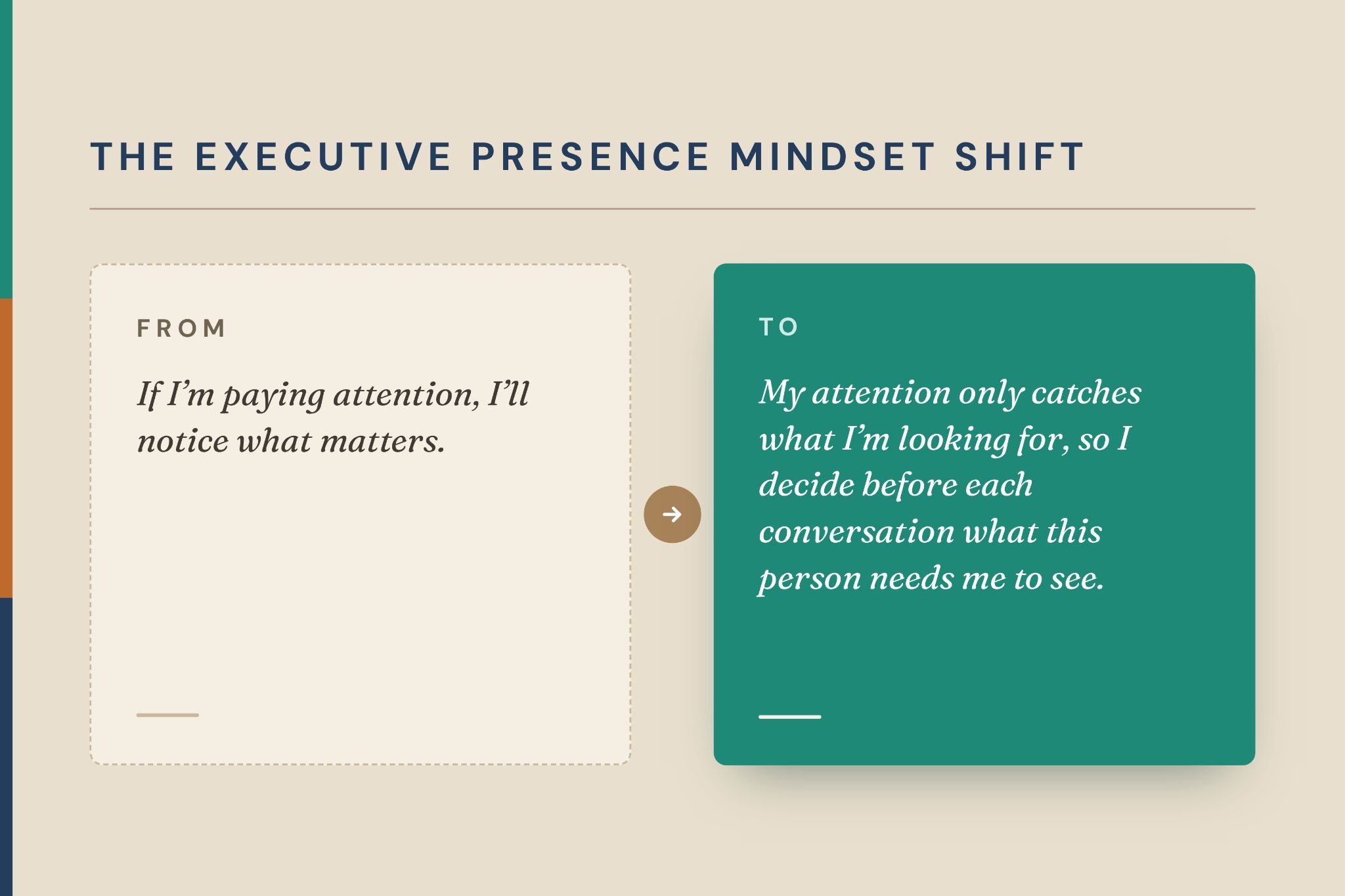
Being present in meetings isn't about looking attentive. Most people already nod, make eye contact, and say "mm." It's about deciding, before the conversation starts, what you're there to pay attention to. Sometimes that means leaving your own questions until later.
It's worth being realistic here. Nobody can attend to everything, and leaders do need to get through their own agendas. The point isn't to abandon them. It's to notice which conversations need you counting passes and which need you looking up.
Changing What You're Counting
The simplest shift is to change the question you bring in. Instead of "What do I need from this conversation?" try "What does this person need from me today?" They lead to very different conversations.
There's a useful test afterward, too. When an important conversation ends, ask yourself what the other person was most concerned about. If you can't say, you were probably counting passes.
It helps, too, to leave a little room between conversations. Even a minute to close out the last meeting, and jot down what's still on your mind, makes it easier to arrive properly at the next one.
That question also changes how you respond to what you hear. If someone raises a problem and you're tuned to your own agenda, you'll reach for a solution. If you're tuned to them, you might ask whether they want a solution at all, or whether there are any other options they've been weighing that they'd rather talk through first.
Attention of this kind is felt, even when it isn't named. People can tell whether you were with them or somewhere else, and it shapes how valued they feel far more than anything you say afterward. If you've been thinking about how to make people feel valued at work, this is where much of it starts.
A lot of executive presence coaching focuses on how leaders show up in a room. Just as much depends on what they notice once they're there. At Coach Vikram & Company, we would say that being present isn't about seeing everything. It's about deciding, before you walk in, what you're there to see.