
The meeting went well. You presented the plan, the questions were reasonable, and the senior leader at the head of the table said, “Let’s go with it.” Two weeks later, you hear through someone else that she had doubts from the start, and that her real concern was never the budget you spent twenty minutes defending. It was the timeline. She had mentioned it once, almost in passing, near the end.
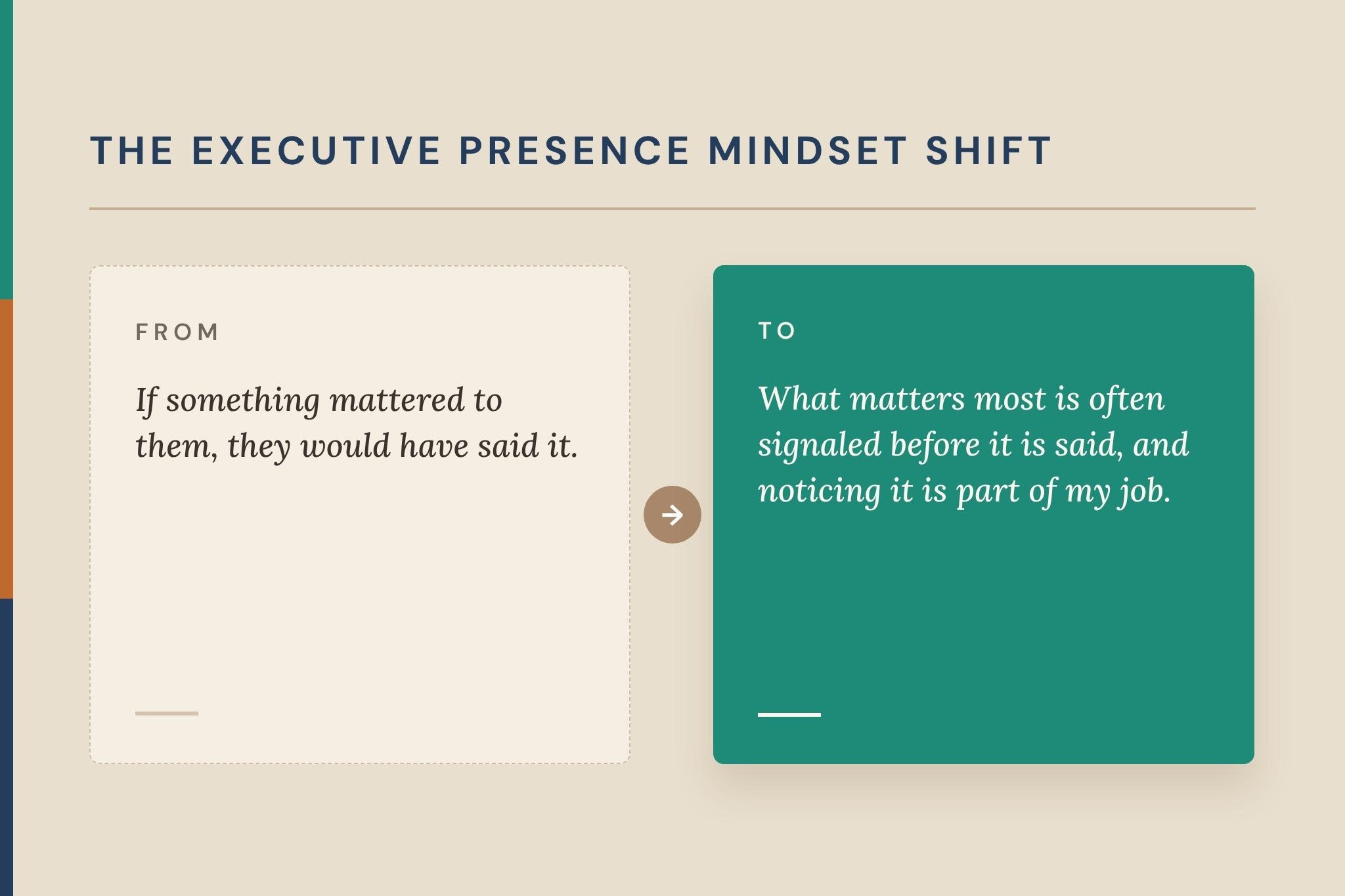
Nobody hid anything from you. The expectation was there the whole time. It just was not in the words.
This is one of the quieter gaps between being very good at your job and being effective at a senior level. Inside your own area, expectations are mostly explicit, because people tell the expert what they need. As the conversations get bigger, more of what matters arrives indirectly. Learning how to be more observant is less about a new skill than about three shifts in where your attention goes.
Shift 1: Keep Part of Your Attention on Them
When you are presenting, most of your attention is on your own material: the next point, the number you need to get right, the objection you prepared for. Deep expertise makes this harder, because there is always more of your own content competing for attention. The result is that the most important information in the room, how others are responding, gets very little of it.
The shift is simple to describe and harder to practice: decide beforehand that a share of your attention belongs to the people across the table. Watch where their energy rises and where it drops. A useful starting point is one person: the most senior person present, or the one whose support you need most. Much of executive presence coaching at senior levels turns out to be about exactly this. Not saying more, but noticing more before you speak.
Shift 2: Track Patterns, Not Single Cues
Unspoken expectations leave traces. A question asked twice in slightly different forms usually means the first answer did not settle it. A “that makes sense” offered while someone is already looking at the next slide is not quite agreement. When a stakeholder asks whether there are any other options, it is rarely a request for a longer list. More often, it is the clearest signal you will get that the current one has not landed.
Noticing tone of voice matters as much as the words. “Interesting” can mean genuinely interesting, or it can mean doubts nobody is going to raise right now. There are also signs someone disagrees with you without saying so: agreement that arrives a beat too late, a sudden move to logistics, a polite suggestion to take it offline.
A single cue proves very little, though. Folded arms might mean resistance, or a cold room. These nonverbal cues at work become useful when they form a pattern. A large review of the research found that people who judge others’ behavior more accurately also tend to show stronger social and work competencies (Hall, Andrzejewski and Yopchick, 2009).
Shift 3: Check What You Noticed Before You Act
Observation without checking turns into guesswork, and guesswork turns into stories you tell yourself about people. Leaders who seem to sense what others expect are often just quicker to name what they noticed, lightly, and ask. “You’ve asked about the timeline twice now. Is that the part you’re most uneasy about?” Most people are relieved to be asked.
This matters even more across cultures, where disagreement may be spoken plainly in one setting and signaled through silence in another. Checking respects both. At Coach Vikram & Company, we would say that what senior people leave unsaid is still part of the brief, and a leader’s job is to treat it that way.
The same attention works with the people who report to you. A team member who has stopped volunteering ideas is sending a signal too, and noticing it early matters, because how to motivate your team often comes down to one well-timed conversation with the person who has started holding back.