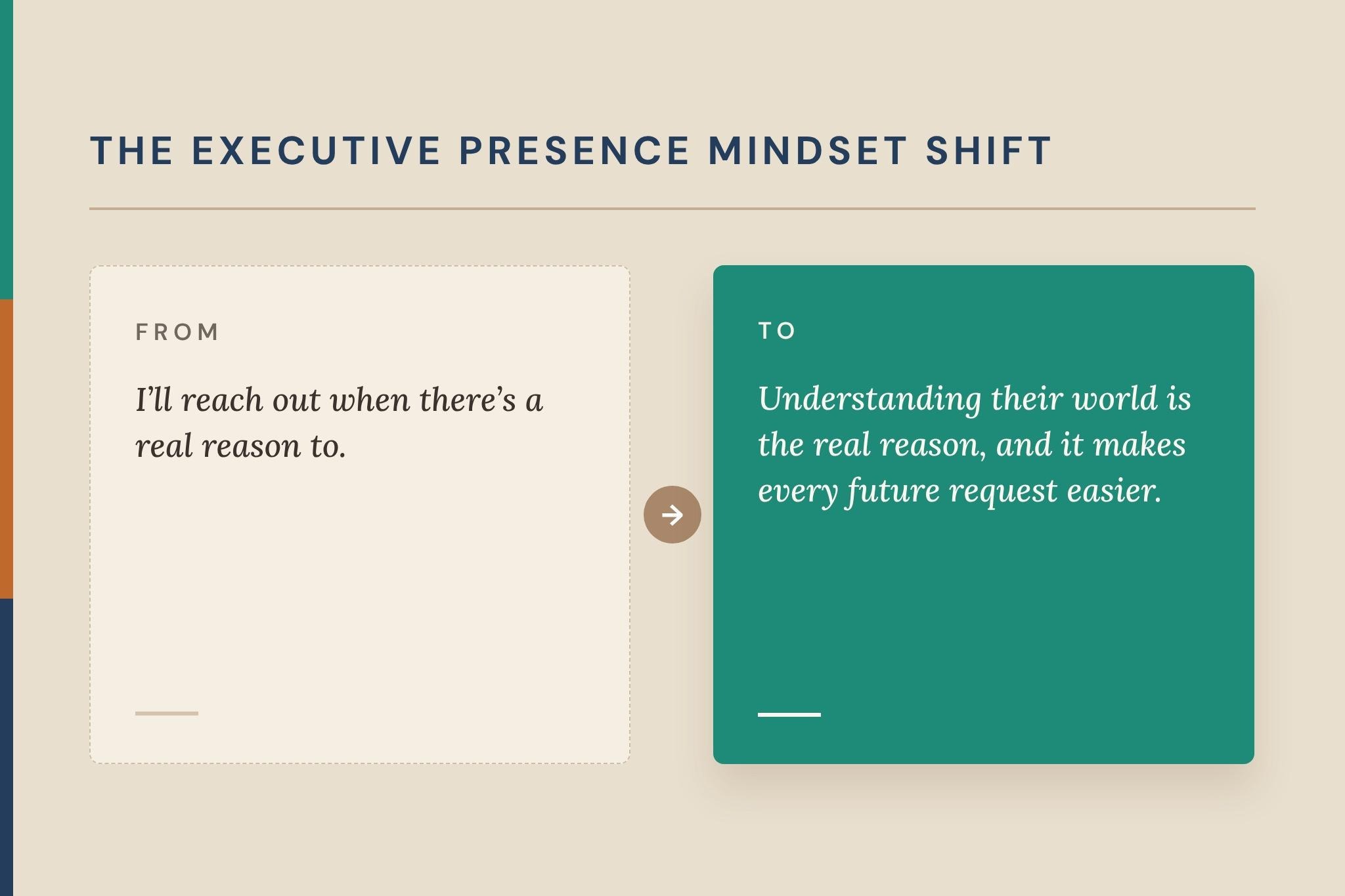

You know exactly whom to call when you need something approved: the regulator’s office, the partner organization, the senior leader in another region. The calls are cordial and efficient. You state the request, they say what they can do, and everyone moves on. Then something difficult comes up, a delay, a dispute, a request that needs real goodwill, and you realize the relationship has never carried more weight than a transaction.
Many capable leaders run most of their external relationships this way without ever choosing to. It happens naturally when work is busy and contact is driven by need. The trouble is that the other side can feel it, and a relationship that only comes alive when you want something teaches people to treat you the same way. Over time, they stop offering more than the request requires.
Part of the reason is discomfort. Research on professional networking found that building relationships in pursuit of career goals could leave people feeling morally uncomfortable, which in turn made them network less often (Casciaro, Gino and Kouchaki, 2014). So leaders contact people only when there is a business reason, and the relationship becomes entirely about business reasons. Learning to build rapport with stakeholders is not about networking harder. It is about three habits of curiosity.
Habit 1: Ask About Their Agenda Before Yours
With a regulator, a partner, or a senior leader in another business, interest means asking what they are trying to achieve this year, what is making their job harder, and what they wish people in your position understood about it. Genuine interest of this kind does not feel calculated, because it isn’t. You are trying to understand them, not extract something from them. The questions do not need to be clever. What matters is that you ask them early, before your own agenda takes over, and leave room for a full answer.
Those questions often reveal shared ground a transactional conversation would never surface: a goal you could help with, a problem you are both trying to solve. When a stakeholder later asks whether there are any other options, you are far more likely to have one that works for both of you.
Habit 2: Remember What They Tell You
Curiosity that forgets is barely curiosity at all. After each conversation, a single line about what the person is working toward or worried about is enough. The next time you speak, you start from their world rather than yours. Knowing you will write something down also changes what you notice, because you start paying closer attention to what people care about.
Remembering also travels well across cultures. In some places, relationships grow over several unhurried conversations before business is discussed. In others, people prefer to get straight to the point and build trust through reliability. Either way, showing you remembered what mattered to someone is welcome almost everywhere. It quietly signals that they were worth paying attention to.
Habit 3: Make Contact When You Need Nothing
The strongest signal of real interest is contact without a request. A short note when you come across something relevant to what they mentioned does more for the relationship than a dozen polite meetings, precisely because nothing is being asked. The form can vary: a congratulation on a milestone, an introduction to someone useful, a question about something they mentioned last time. All of them say the same thing, that this relationship matters beyond the next request.
Transactional relationships cost more than goodwill. Leaders who keep everyone at a distance often find they have nobody to speak to honestly when things get hard, and that distance is part of why it can feel lonely at the top, even when the results are good. They also discover that their influence ends exactly where their formal authority does.
At Coach Vikram & Company, we would say the strongest stakeholder relationships are built in the weeks when nothing is being asked. It is a recurring theme in executive presence coaching for leaders whose roles now depend on people they do not manage and cannot instruct.