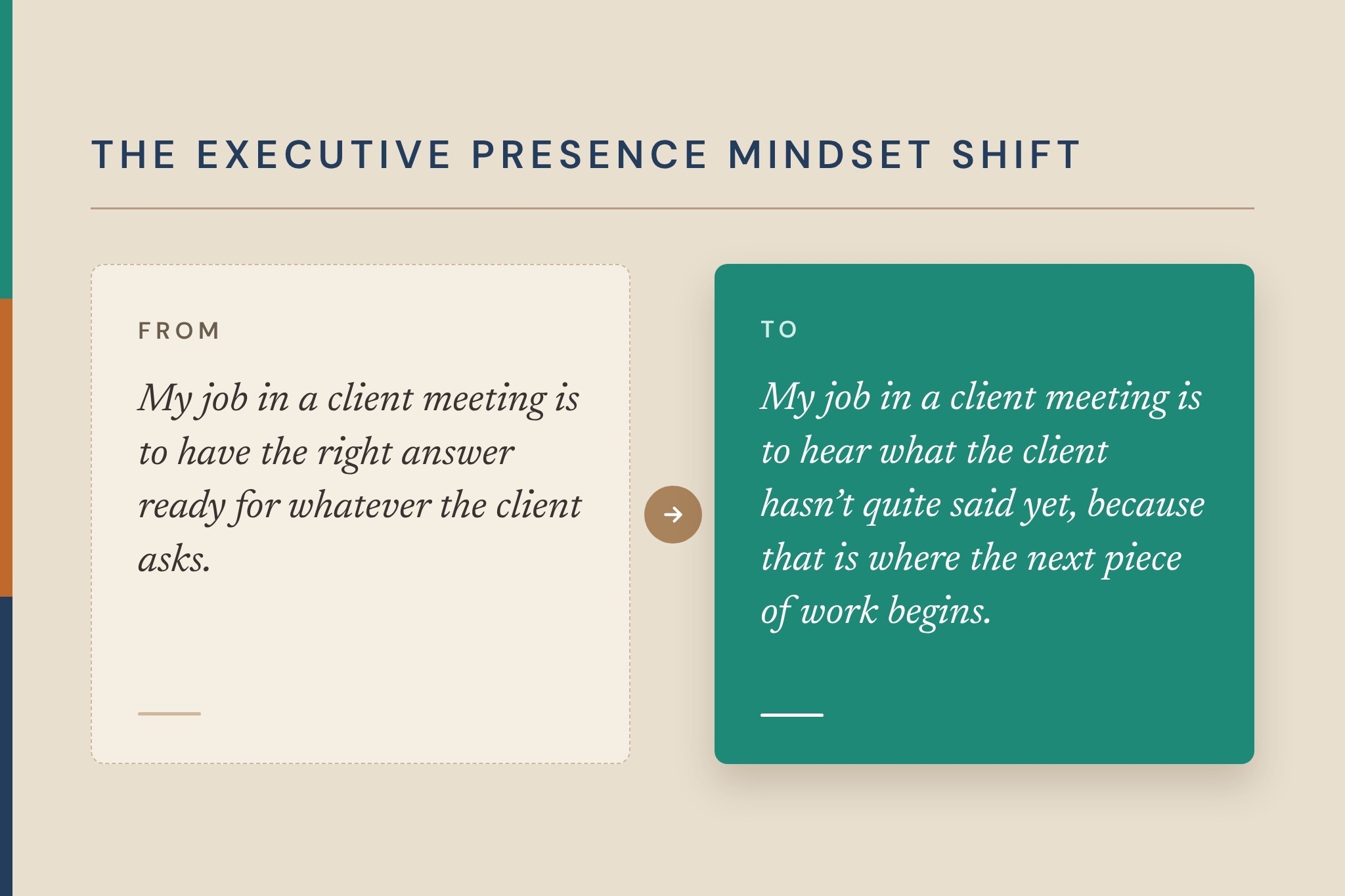

Most delivery leaders have had the experience of reading an RFP from their own client and recognizing every problem in it, because the client has been describing those problems in status calls and workshops for months. The frustrating part is not that the work went to tender but that the signs were spoken out loud in meetings you attended, while your attention was fixed on the program in front of you.
That focus is understandable, because delivery leaders are rewarded for keeping the current work on track, and a status call can easily become a list of items to answer rather than a conversation to take in. Yet clients reveal a great deal about what is coming next in the way they describe what is happening now, and the leader who hears it first usually has the best chance of being asked to help.
Knowing how to listen to clients in this way pays off far beyond any single deal, because a review of research on listening at work found that being listened to well is linked to better performance, stronger relationships, greater trust, and a deeper understanding of the job (Kluger and Itzchakov, 2022).
Listen for the Problem Underneath the Request
Every request a client makes is shaped by a problem they are trying to solve, and the request itself is often only one possible answer to it. When a client asks for a new report, the real need might be a question their leadership keeps asking that nobody can currently answer, and that question may point to a much larger piece of work.
Hearing what the client is really asking means letting them finish describing the request and then asking what prompted it, before you start working out how to deliver it, and most clients appreciate the question because it shows that you care about the outcome rather than simply the task. The gap between client requirements vs real needs is usually where the next initiative is hiding, and it tends to become visible only to the person who stays curious for one more question.
Listen for the Words They Have Borrowed from Their Leadership
Clients tend to repeat the language they hear from their own executives, so a new phrase that starts appearing in your meetings, such as “consolidation”, “platform strategy”, or “next year’s budget”, often signals a priority that has been set somewhere above them. These borrowed words are among the earliest clues to where the client’s investment is about to go.
Active listening in client meetings includes noticing these shifts in vocabulary and asking about them directly, perhaps by saying that you have heard the phrase a few times recently and would like to understand what it means for their plans. Asking whether there are any other options they are exploring at that level can open a conversation that no tender document would ever give you.
Listen to the People Outside the Steering Committee
The people who use your client’s systems every day, from operations teams to service desks, often know about the next problem months before it reaches the steering committee. Their frustrations and workarounds are early versions of the requirements that will later appear in a business case. A service desk lead who mentions that the same ticket keeps coming back is often describing, without realizing it, the business case your client will write next year.
Making time for these conversations is one of the most practical listening skills for client-facing roles, because it gives you a view of the organization that the people you usually meet cannot always see themselves. It also tends to earn you allies inside the client who will mention your name when the next initiative takes shape.
All of this depends on being fully in the conversation rather than half-planning your response, which is why it helps to learn how to stay with the conversation instead of getting lost in your head, especially in long status calls where the most useful remarks are the easiest to miss.
At Coach Vikram & Company, we would say that your delivery experience is your advantage here, because you are in the room every week while the client’s next priorities are still being talked about rather than written down. Leaders who come to executive presence coaching often find that the deals they win most easily are the ones they heard forming long before anyone else knew they existed.