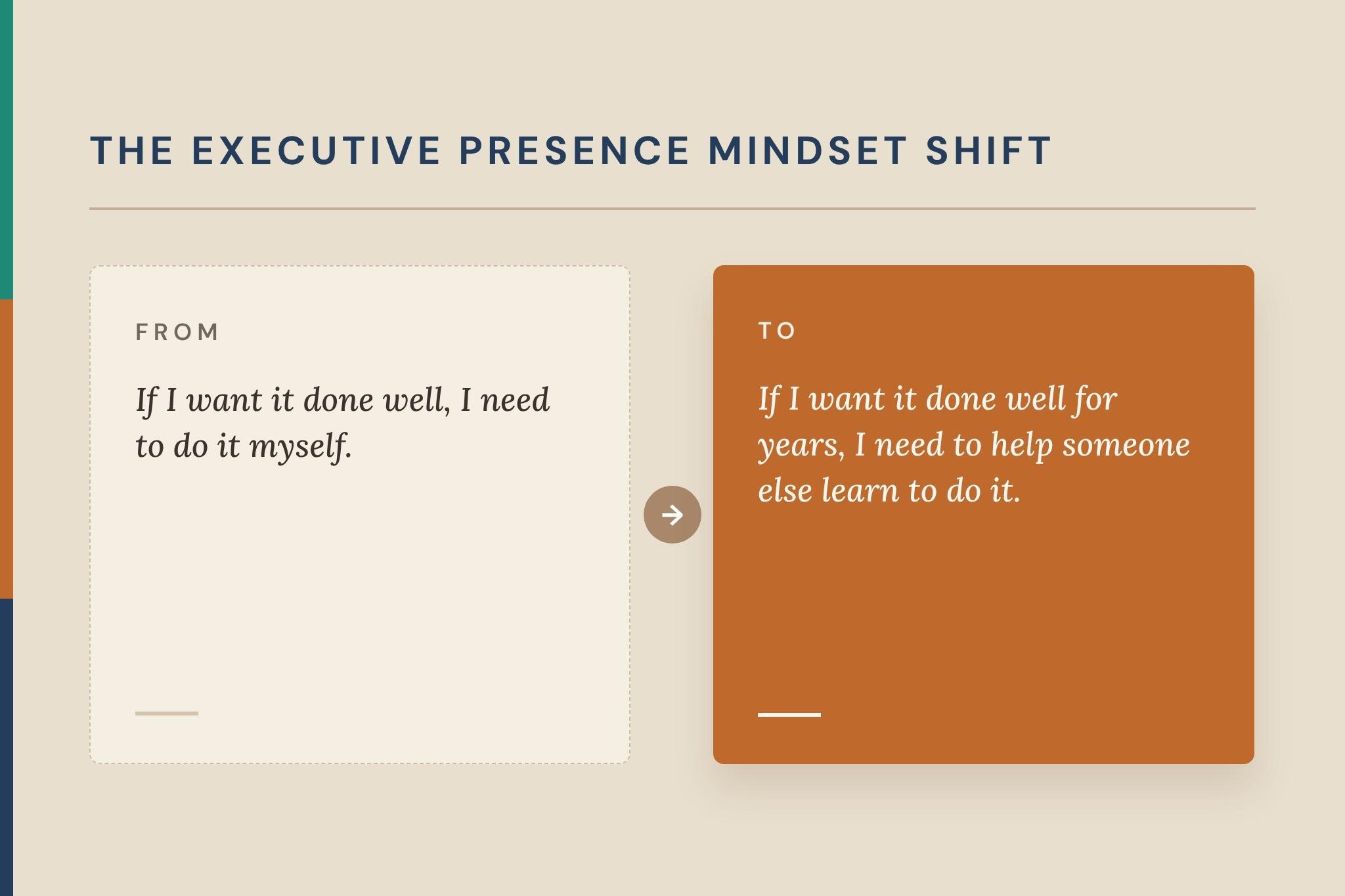

It is late on a weeknight and you are reworking a document someone on your team drafted. It was fine. Not quite how you would have done it, but fine. You change the structure, tighten the numbers, and rewrite the summary. It takes an hour. You tell yourself it is quicker this way, and in a narrow sense it is.
Many senior leaders got where they are because they were the safe pair of hands who would make it happen. That reputation was earned. The difficulty is that the habits that built it can quietly start to work against the people around you. On a team where the leader always steps in, people bring problems instead of proposals, the most capable stop stretching, and the leader becomes more indispensable and less free to take on a bigger role.
Helping employees reach their potential asks something uncomfortable of the leader: to let work be done a little differently, a little slower, and now and then a little worse, for a while. It can be done in three steps.
Step 1: Hand Over Work That Stretches, Not Work That Swamps
People tend to grow most through work that pushes them past what they already know, but challenge has limits. A study of managers’ on-the-job experiences found that development rose with challenge only up to a point, after which the gains tailed off, and that access to feedback offset much of that decline (DeRue and Wellman, 2009).
Handing someone an impossible task and walking away is not development, and neither is handing over only what they can already do. The useful zone is work that feels slightly too big, with you close enough to give honest feedback. Agree on what “good” looks like before the work starts, so your feedback is about the standard rather than about your preferred way of doing it. In ordinary terms, that might mean letting someone lead the client call you would normally run, or present the numbers to senior leaders while you sit in the room and say very little.
Step 2: Coach Instead of Rescue
When a team member brings you a problem, the rescuing reflex is to solve it. The uplifting move is to ask what they would try, and then whether they see any other options. It takes longer. It also leaves them better able to handle the next one without you.
Developing your team members means redirecting some of your care from the outcome to the person. The question shifts from “How do I make sure this goes well?” to “How do I make sure this person can make it go well next time?” Much of how to inspire your team comes down to being openly confident in someone a little before they are confident in themselves, as long as that confidence is honest. Coaching also means resisting the urge to step in at the first wobble. A plan that is eighty percent as good as yours, fully owned by someone else, often delivers more than yours would have, because they will fight for it.
Step 3: Quiet the Voice That Says Only You Can Do It
For leaders who built their name on reliability, the hardest part is often internal. A quiet voice says that if you do not check everything, something will slip, and it will be your name on it. That voice shapes behavior long before anyone else sees it. If it is loud, it helps to work on what you say to yourself first, and positive self-talk at work is a practical place to start.
From the outside, constant checking looks like high standards. From the inside, it often feels like the only way to be sure. Noticing that difference is usually what makes the first two steps possible.
At Coach Vikram & Company, we would say the real measure of a leader’s reliability is whether the work still gets done well when they are not in the room. That question comes up often in executive presence coaching with leaders moving into larger roles, because the next level usually depends on the answer.