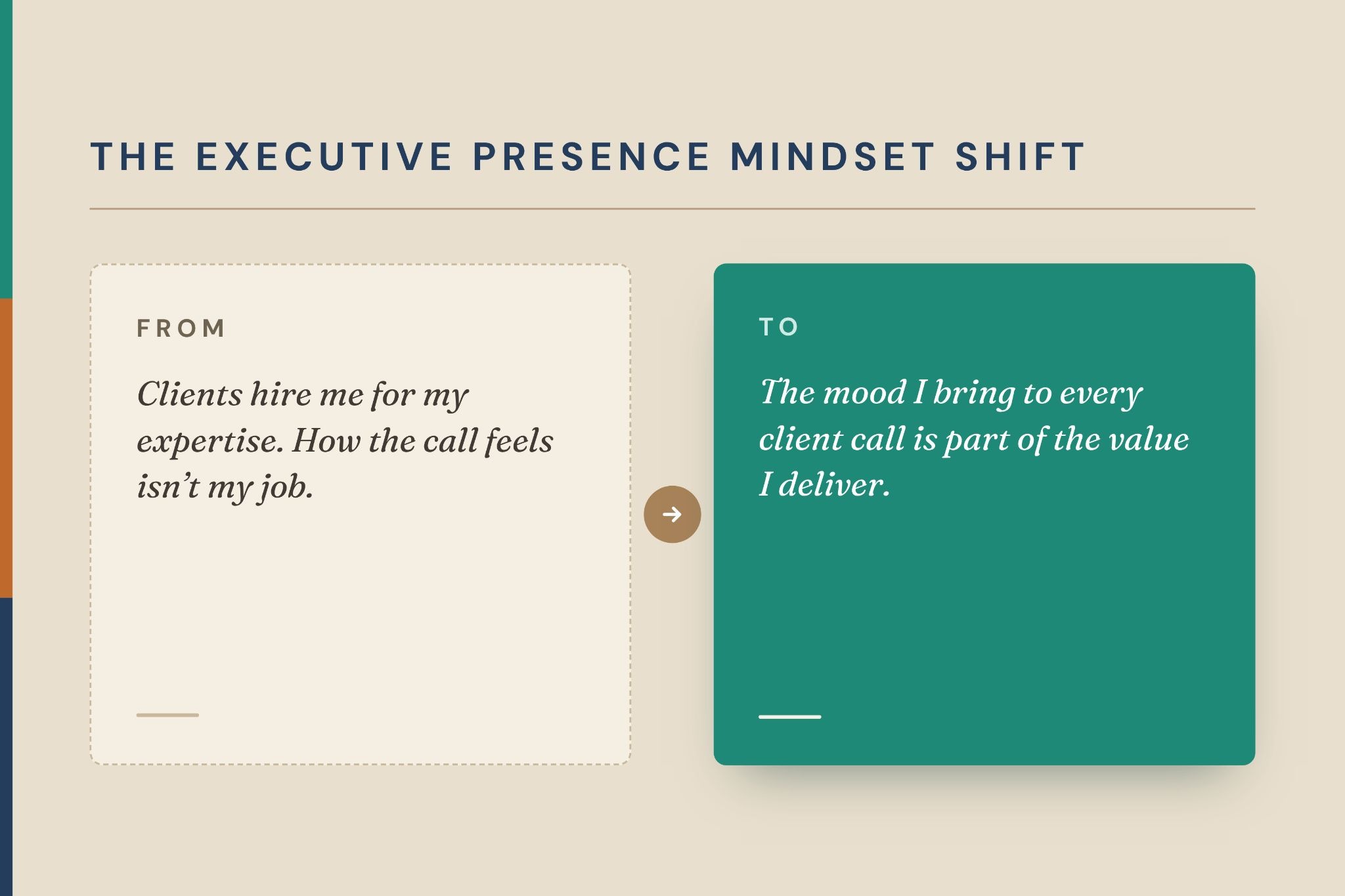


Ask a client to describe their delivery lead and you’ll often hear the same words: reliable, sharp, knows the system inside out. All good. What you rarely hear is that they enjoy working with them.
That gap matters more than it seems. When a client respects your expertise but doesn’t look forward to your calls, the relationship stays transactional. They come to you for answers, not for thinking. Bad news lands harder, because there’s little goodwill to cushion it. And when someone else on the account is “the personable one,” that person ends up owning the relationship you built through delivery.
Many technical experts assume this is a question of personality, and that some people simply have it. But the mood of an interaction is mostly made of choices, and choices can be learned. Knowing how to make clients enjoy working with you is a skill, not a trait.
Research on teams shows why this matters: one person’s mood spreads to the people around them and shapes how the whole group works together, often without anyone noticing (Barsade, 2002). In a client call, the person most likely to set that mood is the one running it.
Shift One: Choose the Mood Before You Join
Most delivery leaders prepare the content of a client call carefully and leave the mood to chance. So the mood becomes whatever they happen to carry in: the pressure of the last escalation, the fatigue of a late call, the worry about the slide with the amber status.
Some of what leaders carry in is their own harsh verdict on last week’s mistakes. Knowing how to stop being so hard on yourself at work makes it far easier to walk into a client call in the mood you chose, not the one you were left with.
Before you join, decide how you want the client to feel when the call ends. Reassured, energized, clear about what’s next. That decision changes small things clients notice: how you greet them, your pace, and whether you sound like you’re bracing for trouble or ready to solve it. On a video call, where clients have little to go on beyond your face and voice, those small things carry even more weight.
Shift Two: Open with Momentum, Not Only Problems
Status calls tend to start with what’s late, blocked, or red. It feels responsible, and it quietly trains the client to expect bad news whenever you appear.
Start instead with one thing that moved forward, then cover the issues. You’re not hiding anything; you’re giving the call a direction. Clients who hear progress first treat problems as things to solve together, not as signs that everything is slipping. It helps your own team too, since they often join these calls braced for criticism. Over time, it’s one of the simplest ways of setting the tone in meetings you lead with clients.
Shift Three: Let Your Enthusiasm Show
Technical experts often flatten their delivery to sound professional. They explain a clever solution in the same voice they use for a risk log. Yet enthusiasm is one of the most persuasive signals you have. When you’re visibly interested in the client’s problem, the client becomes more interested too. Clients rarely remember the architecture diagram. They remember whether the person explaining it seemed to care.
This doesn’t mean performing. It means letting the parts of the work you find genuinely interesting come through in your voice, and saying why a solution excites you, not only how it works. When clients hear that, they start to see a partner who cares about their outcome, not a supplier completing a task.
Why the Mood Is Part of the Work
None of this replaces delivery. It changes how delivery is experienced, and it makes your expertise easier to take in. A client who enjoys working with you gives you more room when things go wrong, brings you in earlier, and is more open when you ask whether there are any other options worth considering.
At Coach Vikram & Company, we would say your delivery experience is your advantage, and the mood you bring is what lets clients feel it. Leaders who come to executive presence coaching often assume the work is about big moments, such as the keynote or the pitch. Many find it is really about the first minute of an ordinary call.
Clients will always need your expertise. Whether they want to keep working with you depends on how it feels to do so.