
The decision is yours to make. You have most of the information, though not all of it. There is a reasonable case for going ahead and a reasonable case for waiting. So you ask for one more analysis. You mention it informally to a senior colleague, hoping they will tell you what they think. A week passes. The opportunity is still there, only slightly smaller.
Nothing about this looks like a confidence problem from the outside. The leader is experienced, respected, and usually right. But when information is incomplete and nobody above them has signaled a view, they hold back. In a specialist role, where precision mattered and mistakes were costly, that caution served them well. In a broader role, where ambiguity is the normal condition, it starts to look like hesitation.
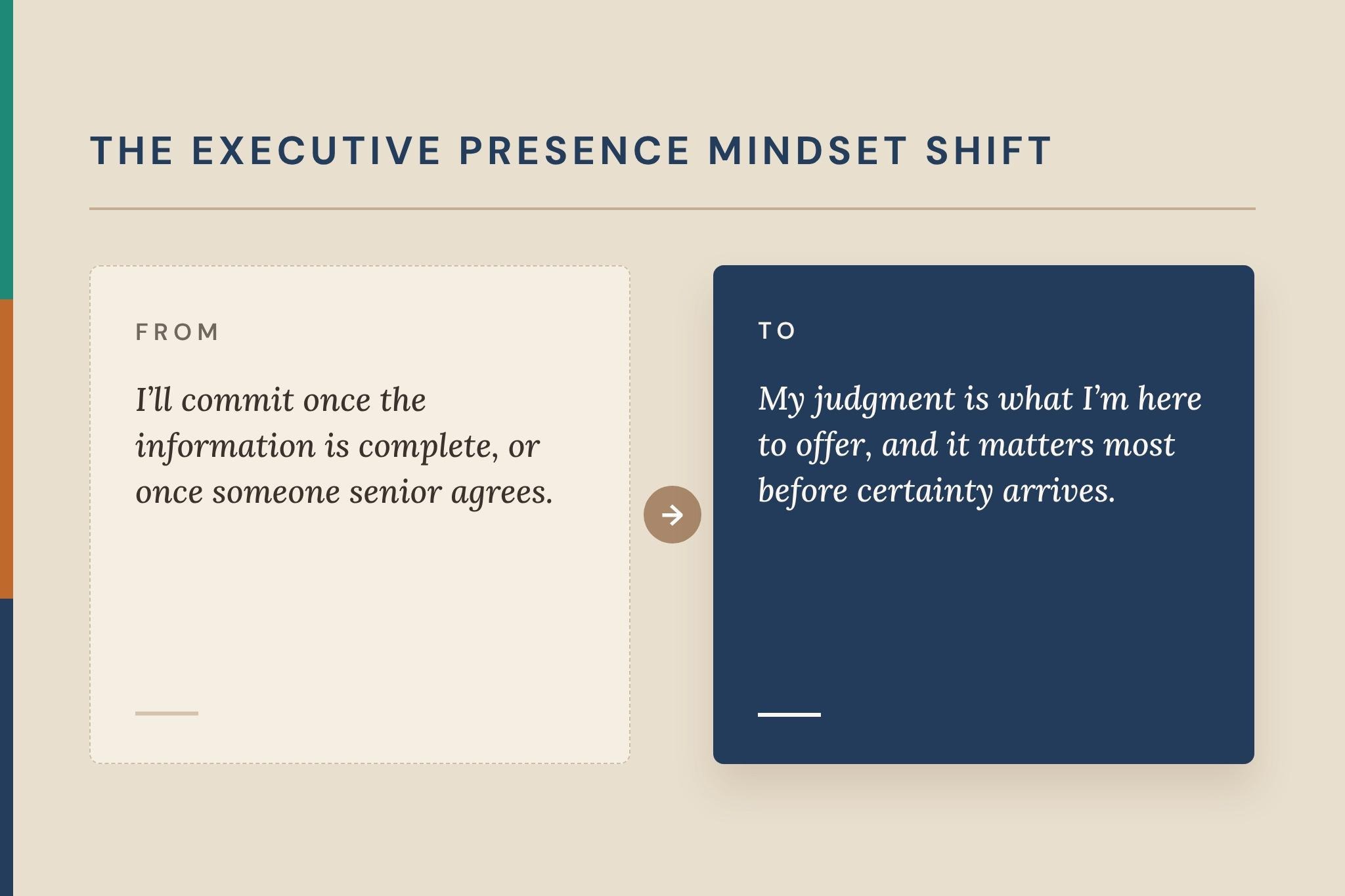
Believing in yourself at work at this stage is not about feeling bolder. It is about trusting your own judgment when the two things you used to rely on, complete data and someone else’s blessing, are no longer available. Three shifts help.
Shift 1: Trust Your Record With the Unknown, Not Your Record of Being Right
Many capable leaders quietly rest their self-belief on being right. That foundation works until the decisions get bigger and murkier, and being right in advance becomes impossible to guarantee.
A steadier foundation is your record of handling the unknown. Almost every experienced leader has taken on something they did not fully understand at the start, a new market, a new team, a crisis nobody predicted, and found their way through it. That record is evidence that you can act before you know everything and adjust as you learn.
It matters, too, because belief in your own capability is closely tied to how well you perform. A large review of workplace studies found a substantial relationship between people’s confidence in their ability to handle a task and how well they actually did it (Stajkovic and Luthans, 1998).
Shift 2: Stop Waiting for Permission You No Longer Need
In many organizations, deferring to seniority is a sign of respect, and checking with someone above you before committing is simply good manners. The difficulty comes when the habit outlives the role. At some point, you become the senior person others are waiting on, and your hesitation holds up their work as well as yours.
Decision-making under uncertainty is, in large part, what senior roles exist for. If every important call needs an informal nod from above, the organization is paying for two people to make one decision. It helps to remember that the people you are waiting on are rarely more certain than you are. They have simply become comfortable deciding without being sure.
This does not mean never consulting anyone. It means consulting for information and challenge, not for permission. A useful test is to ask what new information you are hoping to get. If the honest answer is reassurance, the decision is probably already yours.
Shift 3: State Your Call Plainly, With Its Conditions
Self-belief shows most clearly in how a leader speaks when a decision is open. A long list of caveats signals that you are protecting yourself. A clear recommendation with its conditions signals that you have thought it through. “My recommendation is to proceed. If the second-quarter numbers come in below this level, I would pause” sounds assured, and it is more honest than hedging.
Before you settle, ask whether there are any other options you dismissed too quickly. Then commit, and say so out loud. Attention also matters here. A leader absorbed in how they are coming across has little left for the people in front of them, and the habits that build rapport with your team tend to steady your own footing as well.
At Coach Vikram & Company, we would say that a leader’s judgment is the thing they were brought in to offer, and it is worth most precisely when certainty is missing. It is a recurring theme in executive presence coaching with experienced specialists moving into roles where ambiguity is simply part of the job.