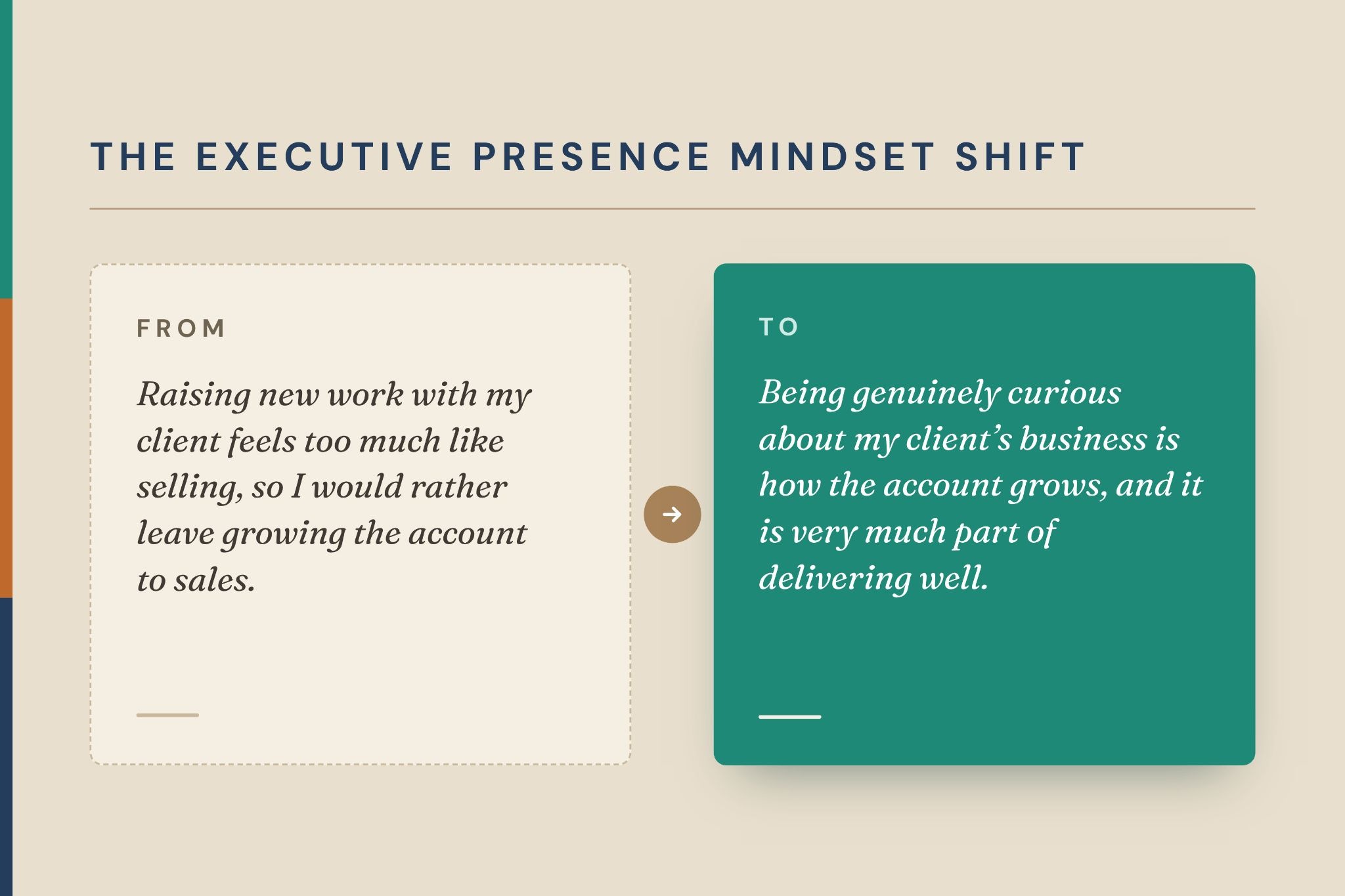


Your account is running well and the client seems genuinely happy, yet almost every new piece of work on it still arrives through sales, even though you probably saw several of those opportunities long before anyone else did and simply chose not to raise them.
That hesitation rarely comes from a shortage of ideas, and far more often from a quiet worry that the moment you mention more work, the client will stop seeing you as the person who solves their problems and start seeing you as someone who wants something from them. So the opportunity reaches the client through someone else, and the relationship you built through delivery does none of the work it could have done.
Growing the account without that discomfort starts with learning how to understand your client’s business, which means asking what is going on for this client that you don’t yet understand, rather than what you could sell them. Curiosity of that kind surfaces needs long before anyone writes a proposal, and it places you in the conversation as the person who noticed something rather than the person who came to pitch.
The research on service relationships points the same way, since one study found that customers who enjoyed their interactions with the people serving them and felt a personal connection to them were more satisfied, more loyal, and more likely to recommend the firm (Gremler and Gwinner, 2000).
Step One: Get Curious About the Work Next to Yours
Your scope is a small window into a much larger business, because the system you maintain feeds another team’s process and the data you deliver ends up in somebody’s monthly report, yet most delivery leaders know the parts on either side of their own hardly at all.
So ask what happens to your work once it leaves your team, or who else in the business depends on it working well. These are some of the simplest discovery questions for clients, and nobody hears them as a pitch, yet they show you where the client is struggling beyond your scope, which is exactly where understanding client needs begins.
Step Two: Come Back to What They Mentioned in Passing
Clients tend to mention their real problems at the edges of a conversation, whether it is a reporting headache, a vendor they are unhappy with, or a deadline their leadership has just moved, and most of us offer a sympathetic word before moving straight on to the agenda.
What makes the difference is writing it down and asking about it the next time you speak, because that small follow-up tells the client you were paying attention to them and not just to the project. It is also the quietest way to uncover client needs, since it gives them a natural opening to tell you more without you having to ask for anything.
Step Three: Offer an Observation, Not a Proposal
When you notice a need you could help with, resist the urge to package it as an offer, and instead share what you have seen and ask what the client makes of it, perhaps by mentioning that your team keeps seeing the same handoff fail between two of their platforms and asking whether they are already looking at it.
An observation like that leaves the client in charge, so they may tell you it isn’t a priority right now, or they may ask whether there are any other options worth considering, which is your invitation to help. By the time the conversation turns to what you could actually do, the idea is as much theirs as it is yours.
Why This Doesn’t Feel Like Selling
Selling begins with your offer while curiosity begins with the client’s situation, which is why the leaders who grow accounts most comfortably are usually the ones who know the client’s business well enough to see what is coming. Approaching your client contact with curiosity rather than judgment is one of the surest ways to help your clients succeed, and a client contact who succeeds tends to bring you into whatever comes next.
At Coach Vikram & Company, we would say that your delivery experience is already your advantage, because you are closer to the client’s real problems than anyone who is trying to sell to them. Leaders who come to executive presence coaching often expect to work on how they pitch, and many discover that the bigger shift lies in their curiosity about the client’s world, which keeps them close to client business goals and lets new work follow naturally.
The account you already deliver is very likely holding your next piece of work, waiting for someone who cares enough to ask about it.