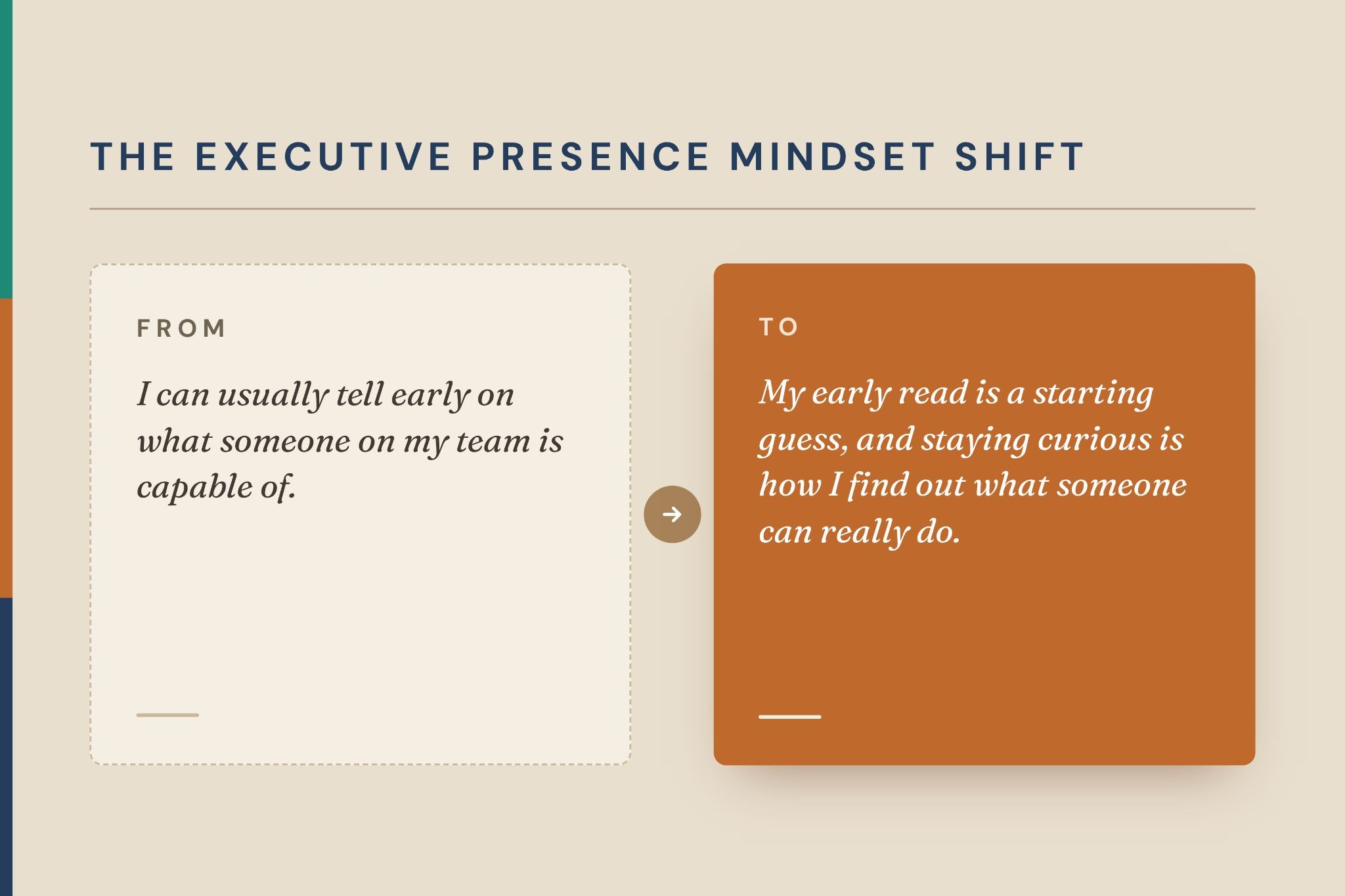


A new hire spends her first three months saying very little in meetings. Her manager files her, without quite deciding to, under "solid but not a high flier." The stretch projects go elsewhere. Eighteen months later, she leaves for a role two levels up at another company, where her new manager describes her as one of the sharpest people they've hired in years.
Nobody was unkind to her. They just stopped looking.
Underestimated at the Dartboard
There's a scene in Ted Lasso that turns on exactly this. Ted challenges Rupert, a wealthy rival who plainly underestimates him, to a game of darts. Before he throws, Ted tells a story. People have underestimated him his whole life, he says, and for years he didn't understand why. Then he saw a quote on a wall, attributed to Walt Whitman: "Be curious, not judgmental." The people who wrote him off, he realized, had never been curious. If they had, they'd have asked whether he played a lot of darts. He did, every Sunday with his father, growing up. Then he finishes the game.
It's worth knowing that there's no good evidence Whitman ever said the line. It's still a useful one. And the scene captures something leaders do all the time: decide what someone is capable of, then stop asking.
How Judgment Closes the Door
Much of how to bring out the best in your team depends on what you believe people can do. Who gets the stretch assignment. Who gets patience after a stumble. Who gets asked for their view when the problem is hard. Those decisions are often made early, on thin evidence, and then quietly confirmed.
There's research behind this. A study of managers found that those who believed people's abilities were largely fixed were less likely to recognize when an employee's performance changed, staying anchored to their first impression (Heslin et al., 2005). The person had moved on. The manager's view of them hadn't.
That's the cost of judgment in leadership: not that it's harsh, but that it's early and sticky. Once someone is filed as "solid but not a high flier," evidence to the contrary tends to get explained away.
It can also fall unevenly. People who are quieter, newer, or simply different from their manager can be the ones filed earliest, because they're harder to read at first.
Curiosity as a Way of Lifting People
Being curious about a team member's potential looks quite ordinary in practice. It sounds like asking, "What would you like to be doing more of?" rather than assuming you know. It's noticing when someone handles a difficult client well and asking what they did. It's giving the quiet person a chance to lead something small and seeing what happens.
A single question can open a lot. Asking someone who seems to be coasting, "What's the most interesting problem you've worked on this year?", often says more about where they could grow than any performance review.
It also means looking for any other options before deciding someone isn't ready. A team member who struggles to speak up in senior meetings may not lack ideas. They may need help learning how to be more assertive at work, which is very different from lacking ability.
None of this means pretending everyone is a hidden star. Some people genuinely aren't ready for the next step yet, and saying so honestly is part of developing them. Curiosity just keeps the question open longer than judgment does.
It's also worth checking your own pattern now and then. Think about who on your team has surprised you in the last year. If the answer is nobody, it may be because you haven't left much room to be surprised.
A lot of executive presence coaching focuses on how leaders are perceived. Just as revealing is how they perceive others. At Coach Vikram & Company, we would say that the leaders who lift people most are often the ones who stay curious about them longest, well past the point where it would be easier to decide.