


A new team member mentions, a little nervously, that she hates presenting. Her manager responds straight away: there's a good public speaking course, he'll send her the link. It's kindly meant. What she hears is that the first thing her manager noticed about her was something to fix.
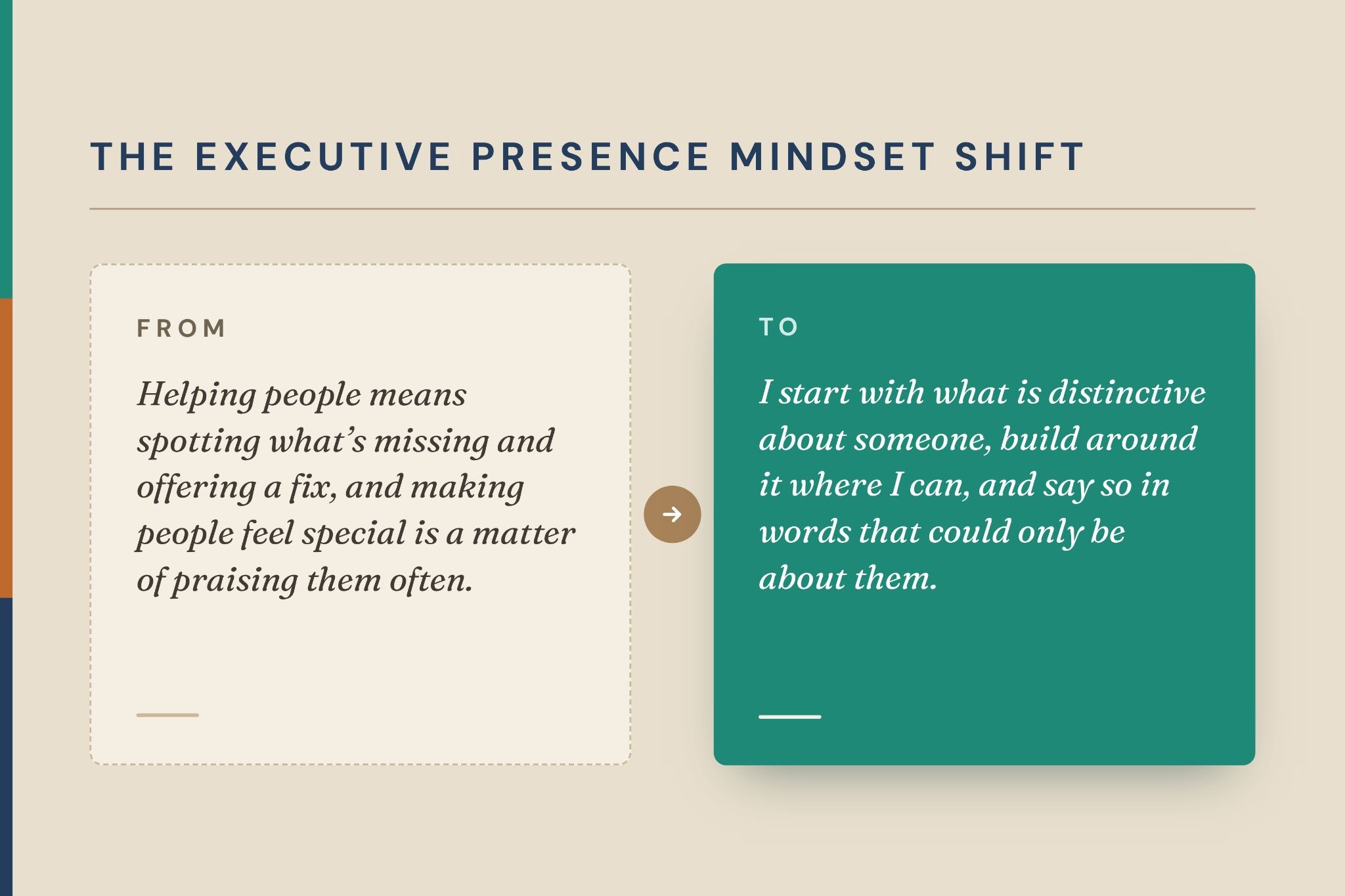
A different manager might have said, "Noted. You write the clearest updates on the team, so let's send yours round before the meeting." Same weakness, same person. One response treats her as a problem to correct. The other builds something around what she's already good at.
The Helpful Response That Lands Wrong
A lot of what gets written about making people feel special at work focuses on praise. But some of the most telling moments come earlier, when someone shows you a weakness. The reflex, especially for conscientious leaders, is to offer a fix. Fixes are useful. They also carry a message, and the message is usually "something is wrong with you."
That doesn't mean weaknesses should be ignored. It means the first response matters. If what someone hears first is what's missing, the fix tends to feel like a verdict.
Leaders who handle this well tend to ask themselves one question before offering a fix: what is this person unusually good at, and is there a way around the weakness that runs through it? Sometimes there isn't, and the course really is the right answer. Often there is.
What Casanova Got Right
In a TEDx talk on the psychology of seduction, the psychiatrist Raj Persaud tells a story about Casanova and an actress with a speech impediment. As Persaud tells it, Casanova disappears for three days and nights and comes back with a play he has written for her, one built so she would never have to say the sound she struggled with.
Persaud then asks the audience whether Casanova had any other options. He did. He could have recommended speech therapy, which would have been far more practical. But the play said something no referral could: nothing about you needs fixing, and this was made for you and nobody else.
Strip away the romance and the story still works at work. What made the gesture land wasn't the effort. It was that it could only have been for her.
It also asked something of him. Three days is a lot. At work, the equivalent is usually much smaller: remembering that one colleague thinks best in writing, or that another does her best work on the hardest problem in the room, and quietly arranging things so they get to.
Why Indiscriminate Praise Doesn't Work
The same talk describes a finding that makes the point from another direction. In a classic experiment, people liked someone more when that person's evaluations of them went from negative to positive than when they had been positive all along (Aronson & Linder, 1965). Persaud's reading is that people are drawn to those they feel they've had an impact on.
At work, the practical lesson isn't to start critical and warm up. That would be a game, and people notice games. It's that praise from someone who praises everything carries almost no information. The person who compliments everyone's slides and everyone's ideas soon becomes background noise. It works the other way too. One accurate observation from someone known to be sparing with praise can stay with a person for years. Specific praise at work means more because it shows you are paying attention and making distinctions.
Recognizing people's strengths out loud has another effect that's easy to miss. Most advice on getting credit for your work assumes people will speak up for themselves. Many capable people won't. When a leader names what's distinctive about them in front of others, part of that job gets done for them.
A lot of executive presence coaching concentrates on how leaders are seen. This is the other direction: how other people see themselves after dealing with you. At Coach Vikram & Company, we would say that the leaders people describe as charming are rarely the most polished ones. They're the ones who made someone else feel like the most interesting person in the room.