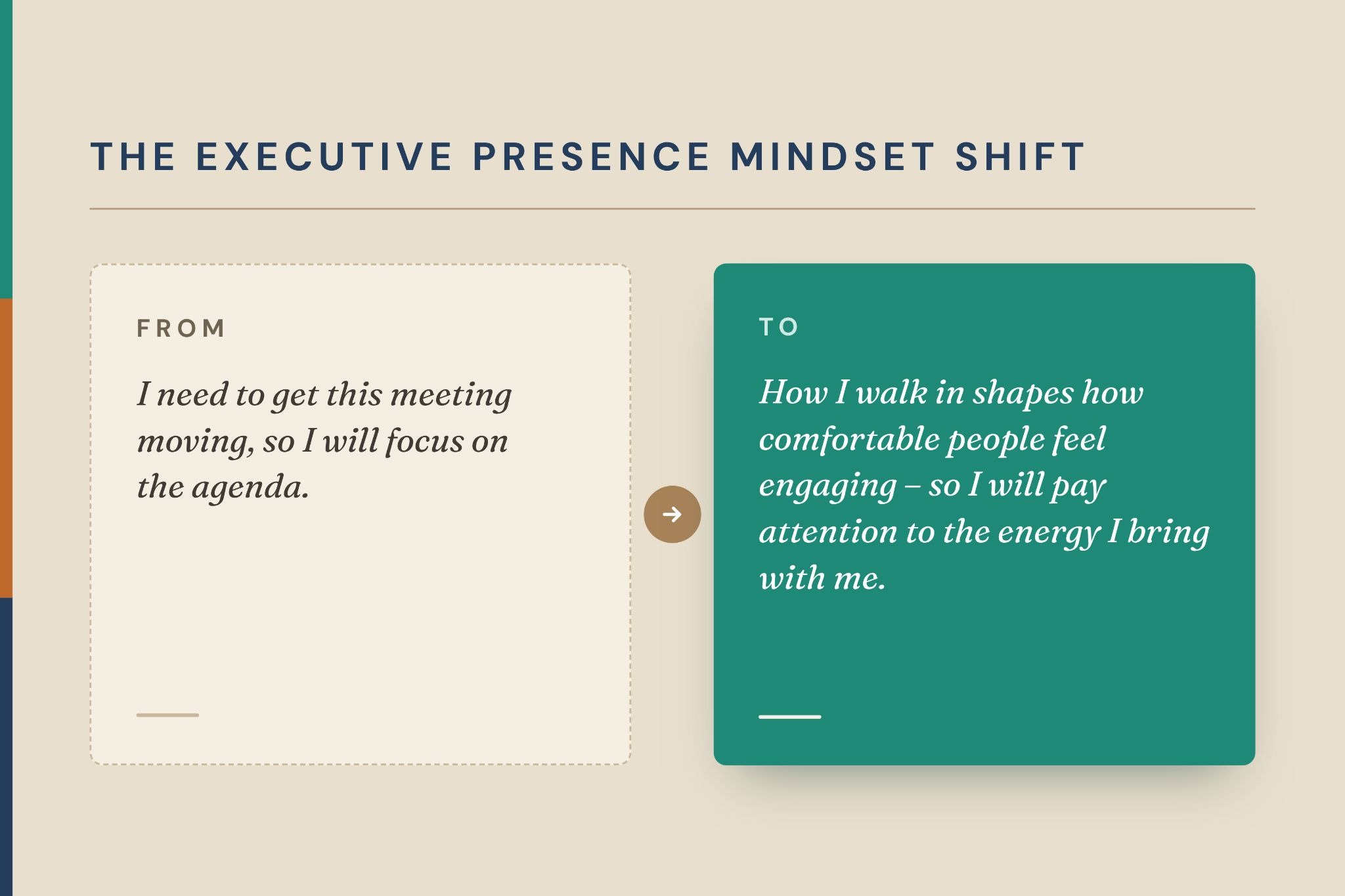
You walk into one room and people seem ready to talk. Someone makes a joke, a hard point gets raised early, and the conversation moves. Then you walk into another meeting – same people, same agenda, roughly the same stakes – and everything feels harder. People are cautious. Answers are shorter. There is a sense that everyone is waiting for something to settle before they can properly engage.
Sometimes the difference is the work. Sometimes it is the person leading the room.
A Group Takes Its Cue From Whoever Is Leading
People read one another constantly, usually without deciding to. Before a leader has made a single substantive point, the room has already taken in their pace, their expression, the tone of their voice.
Research bears this out: a leader's mood shapes the mood of the group and its overall emotional tone. In one study, groups led by someone in a positive mood coordinated better and worked with less effort than groups led by someone in a negative mood. (Sy, Côté & Saavedra, 2005)
None of this requires walking into every meeting cheerful. Energy is not enthusiasm, and personal magnetism is not being the most expressive voice in the room. What matters is the mood a leader sets – through the way they arrive, speak and engage – and whether it makes other people comfortable enough to take part.
Picture a leader arriving straight from a hard conversation. In their own mind they have moved on, but the voice is flatter, the answers come more clipped, the attention is harder to reach. No one says, “You seem irritated.” People just get a little more careful.
The agenda has not changed, but the experience of being in the meeting has.
Energy, in this sense, is the mood you set in an interaction – enough of one that people feel comfortable in it. That comfort does not depend on warmth or constant positivity. It can come just as easily from steadiness, from real attention, from the sense that there is room to speak, question and contribute.
This is what personal magnetism, and much of what people call leadership charisma, actually rests on. People are drawn less to what a leader says than to what it feels like to be around them while they say it.
Your Energy Enters the Room Before Your Message Does
You notice a leader's energy most when it is out of step with the moment.
You can be fully prepared for a meeting and still walk in carrying the frustration of the one before it. Spend a morning solving problems, and you may start treating every new question as one more problem to solve. Answer an email while someone is talking, and you have told them – without meaning to – that they have only part of you.
None of this is intended. That is exactly why it is worth catching.
The seam between two interactions is where this happens. Move straight from one difficult conversation into the next and the residue of the first quietly seeps into the second. A small pause – even a few seconds – lets you decide what to carry forward and what to leave at the door.
It does not take much. Slow your pace, breathe out, set the last conversation aside, and bring to mind the people you are about to see. Decide you want this one to feel calm, or open, or focused. This is not performing a mood; it is choosing the one you arrive with.
At Coach Vikram & Company, we understand how that choice is most of what setting the tone in meetings really means, and it changes how people experience you.
It also changes what the conversation can hold. When people are at ease with a leader, they will raise the awkward point, ask for the clarification, disagree – without first having to manage how the leader might react.
None of which means every interaction should feel easy. You can put people at ease and still challenge them, hold a firm line, or deliver a decision they will not like. Magnetism is not the absence of tension. It is what lets people stay in the tension with you instead of being shut out by it. And often enough, how people experience your presence is what decides whether they ever fully register the expertise behind your work.