
You have been asked for a quick update. You know the subject better than anyone in the meeting, and that is exactly the problem. You start with the background, because the background matters. Then the method, because without it the numbers could be misread. By the time you reach what you actually think, someone senior has glanced at the clock and asked, kindly, “So what’s the bottom line?”
Few moments are more frustrating for a capable expert. The thinking was sound and the data was right, yet the point arrived late, and the room had already decided you were someone who goes into detail.
Advice on how to communicate clearly at work usually comes down to “keep it simple.” For experienced specialists, the problem is more specific than that. They can explain things perfectly well. What they cannot easily do is forget what they know.
Why Expertise Makes You Ramble
Economists have a name for this: the curse of knowledge. Better-informed people find it hard to set aside what they know, even when it would serve them to do so (Camerer, Loewenstein and Weber, 1989). In a meeting, it looks like an expert who cannot imagine the conclusion making sense without the full journey that led to it. So they take everyone on the whole journey.
From the inside, this feels like rigor. From the outside, it can look like a lack of judgment about what matters. Senior audiences are rarely asking you to prove you did the work. They assume you did. They want to know what it means, what you recommend, and what they need to decide.
That is why so many people look up how to stop rambling after a meeting that went sideways. Rambling is rarely about talking too much in general. It comes from not having decided, before speaking, what the one point is.
Lead With the Insight, Then Earn the Detail
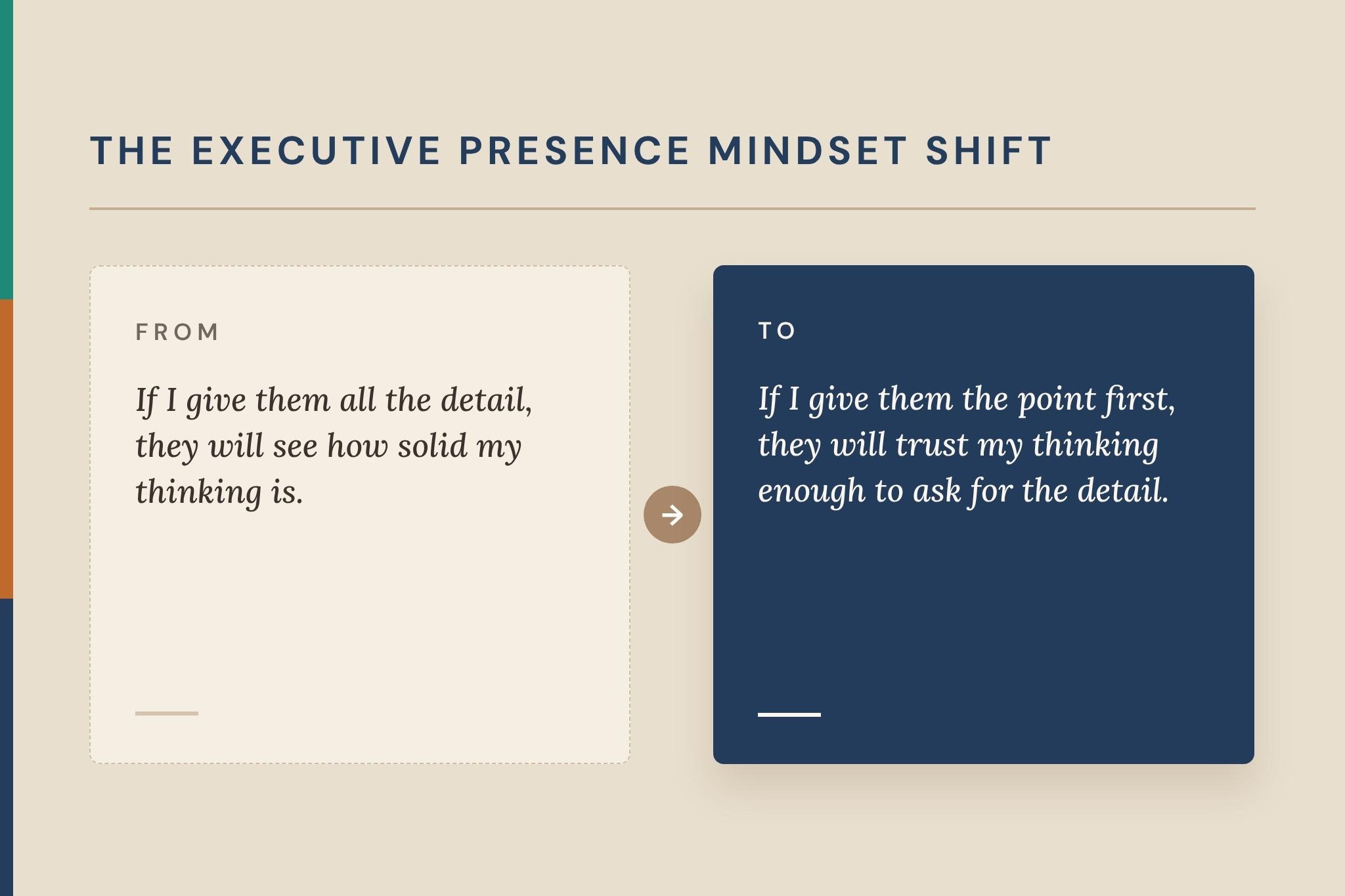
The simplest structural change is to reverse the order. Start where you would normally finish. “My recommendation is that we delay the launch by a quarter. There are two reasons.” Then pause and see what they want next. One person will ask for the data, another about risk, and someone may simply agree. Each response tells you where to go, which beats guessing and delivering everything.
Knowing how to get to the point does not mean throwing the detail away. It means changing its job. Detail stops being the introduction and becomes the evidence, there when someone asks for it. Experts who make this shift often find that their depth comes across more strongly, because it shows up as sharp answers to real questions rather than as a wall of slides.
A useful test: if someone asks whether there are any other options, can you name each one in a sentence? If not, the analysis may be finished, but the message is not.
Structure Is a Form of Composure
There is a reason this behavior sits close to composure. Rambling often starts with a small flicker of anxiety, the worry that a short answer will look shallow, or that someone will challenge a point you did not explain. More detail feels like protection. Mostly, it isn’t. Speaking concisely in meetings signals that you trust your thinking enough to let others ask for more.
Structuring your thoughts before speaking does more than any technique used in the moment. Before an important update, write down three things: your point, the reason behind it, and what you need from the people in the room. If you cannot write the point in one sentence, you are not ready to say it in one.
How you open also shapes how the rest lands, which is why setting the tone in meetings starts before your first point does. At Coach Vikram & Company, we would say that clarity is less a speaking skill than a decision you make beforehand about what matters most. Much of executive presence coaching with technical and functional leaders comes back to that one habit.