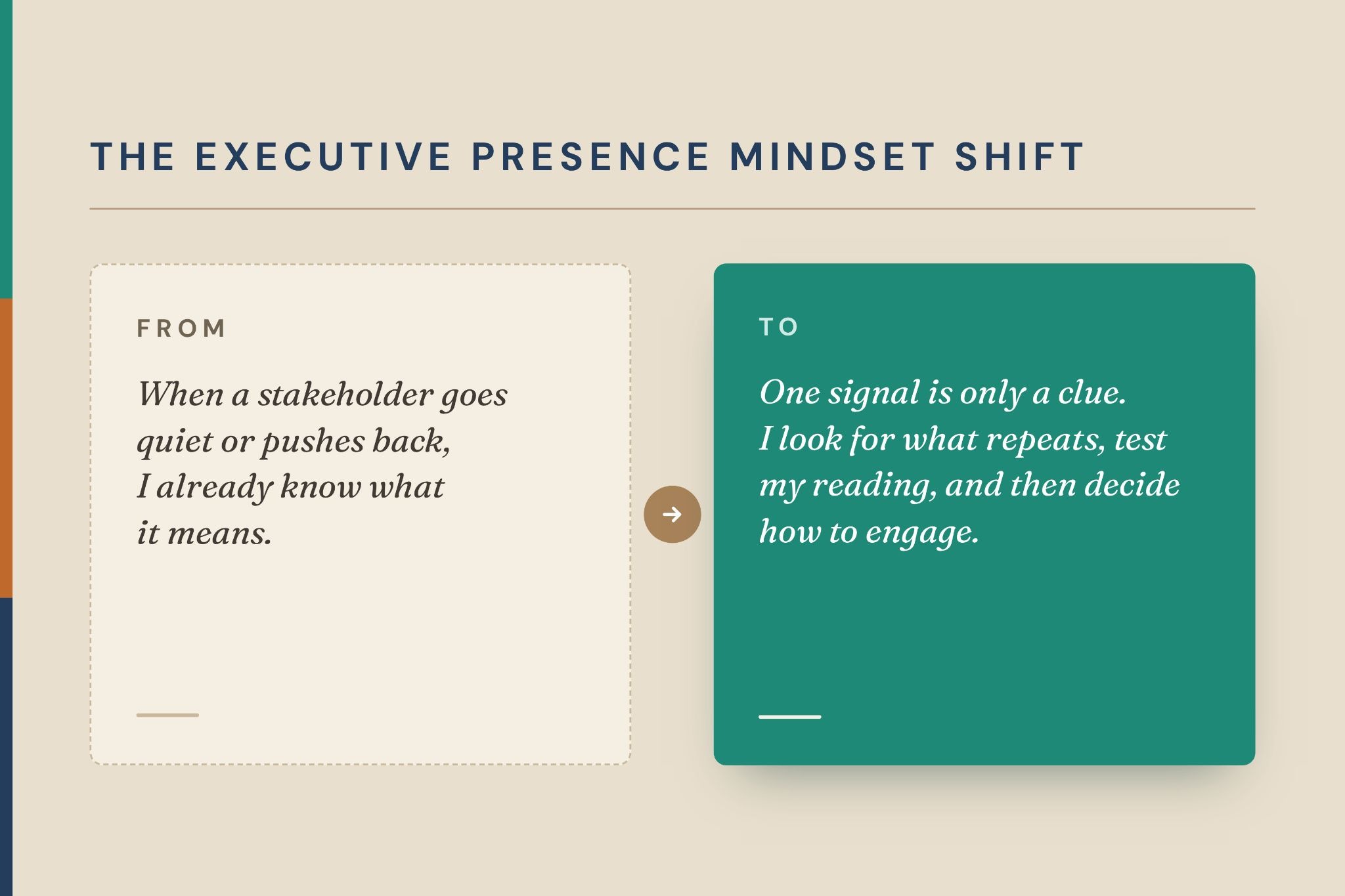


You walk into a meeting and one stakeholder is unusually quiet. Another keeps circling back to the same concern. The signals are easy to catch. Knowing what they mean is harder.
That is where insight begins.
Observation tells you what happened. Insight asks what connects those moments.
A single pause may mean almost nothing. The same pause, showing up across meetings, decisions, and conversations, means a good deal more.
Say a stakeholder has started pushing back on your proposals more often. You could decide they have lost confidence in you. Or that they are simply being difficult.
Either might be true. Neither is proven by the pushback itself.
Insight means holding your first explanation loosely, long enough to look for repetition.
Do they challenge everyone, or mostly you? Does the pushback appear when a decision lands on their team? Does it happen when they are being asked to commit to something they did not help shape?
The pattern is what gives the signal its meaning.
An executive presence assessment can offer another lens on this kind of pattern, helping you examine not just what is happening around you, but the behaviours you may be bringing into these interactions yourself.
An observant leader notices that someone has gone quiet. An insightful one notices that the same person goes quiet whenever the conversation turns towards a decision they will have to carry.
Your Own State Can Distort the Pattern
There is a further complication: you are part of the interaction you are trying to read.
When a meeting matters enormously to you, your attention can narrow around whatever feels most threatening or important. Psychologist J. A. Easterbrook's work on emotion and cue utilisation found that emotional arousal can shrink the range of cues a person takes in.
Focused on how you are landing, you can stop noticing how the room is actually responding.
So the more a meeting feels like it counts, the more useful it can be to create a little mental space before you walk in.
Clear the unrelated noise. Get clear on what you need from the conversation. And if the noise is coming from your own inner commentary, Self-Belief is where you examine what you are carrying into the room.
This is where social awareness becomes important. The more aware you are of what is happening within you, the easier it becomes to notice what is happening around you without immediately filtering everything through your own assumptions.
Look for What Repeats
You do not need to become an expert in body language. Trying to decode every gesture usually makes you less accurate, not more.
Reading the room is less about interpreting every movement and more about noticing changes and repetitions.
What shifts when a particular topic comes up? Who becomes more engaged? Who pulls back? What keeps happening across conversations?
These observations can become useful leadership insights when you connect them to context rather than treating them as isolated signals.
A stakeholder who suddenly stops volunteering information is worth noticing. So is the team that leans in whenever you explain the reason behind a decision rather than simply announcing it.
Then test the pattern.
Ask yourself:
What else could explain this?
What has changed?
Does the same behavior show up elsewhere?
What tends to happen just before it?
Are there any other options for explaining what I am seeing?
You might also ask yourself what would we, at Coach Vikram & Company, encourage you to notice in the situation: not simply the behavior in front of you, but the pattern that may sit behind it.
The aim is not to turn people into a code you can crack. People are inconsistent, contexts shift, and the same behaviour can mean different things on different days.
Good insight leaves room for that.
Use the Pattern to Change Your Approach
Insight is worth little if it remains an interesting observation.
Suppose a stakeholder engages more when you bring them in early, but becomes guarded the moment you hand them a finished recommendation. The useful move is not to file them under "resistant."
It is to change how you involve them.
Or imagine a colleague who speaks freely while the discussion is exploratory, then goes silent once the room fills with senior voices. You might draw out their view before the conversation hardens around a position.
This is where stakeholder engagement becomes more thoughtful. You are not simply reacting to what someone does. You are using what you have noticed to decide how, when, and where to engage them.
What executive presence coaching might encourage you to do is look beyond the immediate behaviour and ask a more useful question: what could you change in your own approach that might change the interaction?
That does not mean assuming that every stakeholder behaviour is a response to you. It means recognising that your behaviour is one part of the interaction, and that you have some influence over what happens next.