




You run good meetings. Your team respects you, and your door is always open. Yet when the call ends, everything feels purely functional. The relationship works, but nobody actively wants more of it.
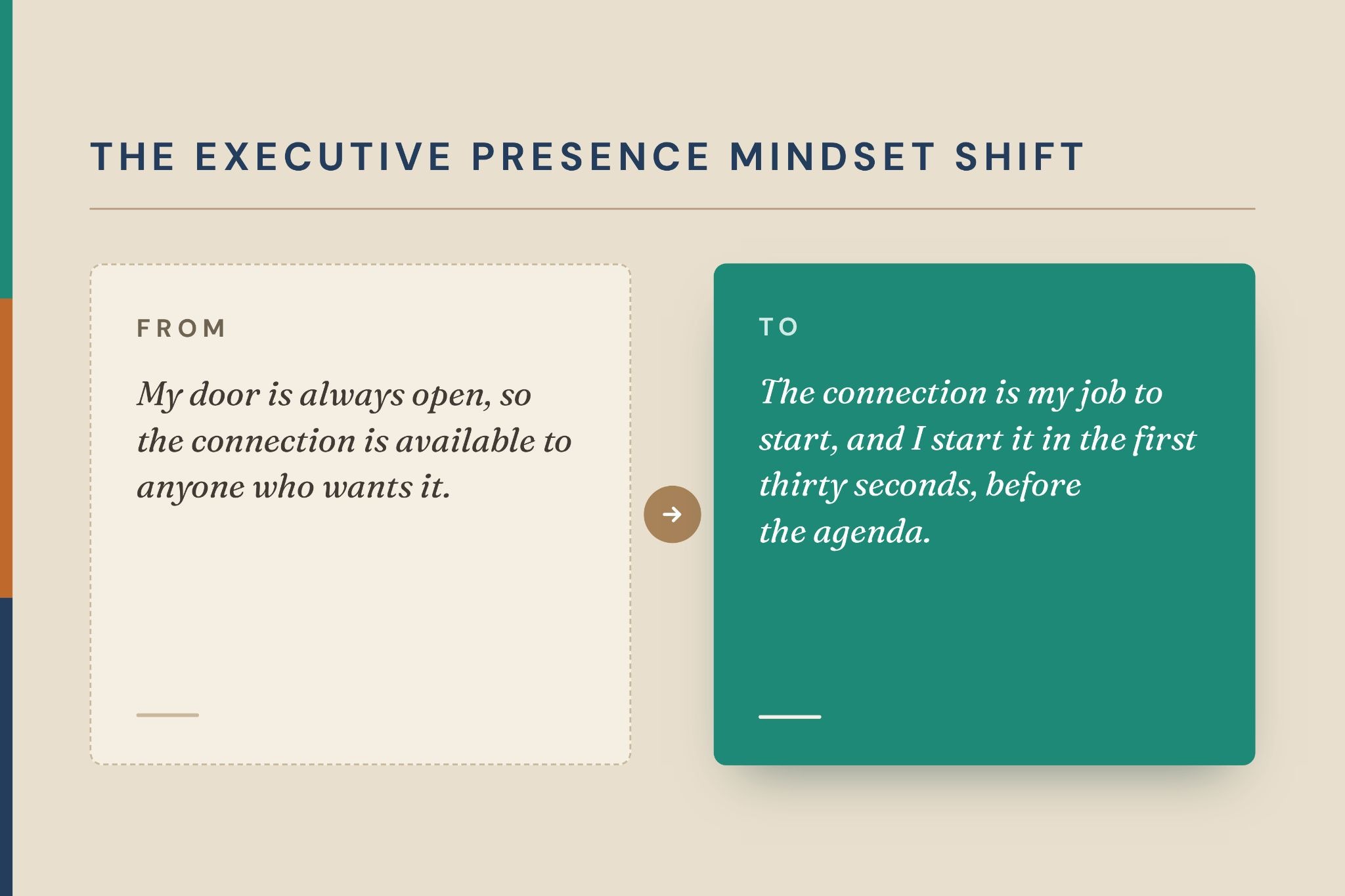
An open door asks the other person to do the hard part. To walk through it, to decide their thing is worth your time, to start the conversation. The people who would most benefit from talking to you are usually the ones least likely to take that on, so the door stays open and stays empty, and it becomes easy to conclude that nobody had anything to raise.
If you have felt that, you have not done anything wrong. You have been leaving the effort to connect with the person least comfortable making it. Taking that effort back is smaller than an open door. It is the first thirty seconds of the conversations you are already having.
The Thirty Seconds That Change the Relationship
Watch what you do at the start of your next one-to-one. Most leaders, especially busy ones, land on the task almost immediately. “Right, let’s get into it.” It feels respectful of everyone’s time, and to the person across from you it lands as a message about what you value, which is what they produce.
The leaders people enjoy working with spend those first thirty seconds differently. They ask something real about the person, and then, which is the part that matters, they do not rush past the answer to get to business. They let the answer be the conversation for a moment.
Curiosity is the one thing people can feel. When you are interested in someone before you need anything from them, they stop managing the interaction and start enjoying it.
The mechanism is not complicated. Ask “how was the weekend” and pivot straight to the numbers, and people clock the reflex, and it counts for nothing. Ask what is actually going on for them and stay long enough to hear it, and you have done something most of their working relationships do not offer, without waiting for them to come to you. Decades of research on self-disclosure find the pattern reliably: people like those they have told something personal to, and they like those who take an interest in return (Collins and Miller, 1994).
This is also among the more commonly skipped behaviours we measure. Across the senior leaders in our sample, more than a third report following up on what someone shared with them less often than once a fortnight, which is to say the conversation happens and then nothing is carried forward from it.
Worth naming one thing: curiosity is difficult to sustain with someone you have already made your mind up about. If there is a person on your team you find hard going, the interest will not land until something else shifts first.
3 WAYS TO PRACTICE THIS WEEK
1. Ask one real question before the agenda, and hold the silence
Ask what’s genuinely going on for them this week, then stop talking and let them answer fully. The silence shows you truly want to know.
2. Write down one personal thing each person tells you, and open with it next time
A house move, a parent in hospital, a course they are excited about. Next conversation, lead with “how did the move go?” A faked interest never remembers, which is exactly why remembering proves it.
3. Be curious in the weeks when you need nothing from them
The trap is that interest surfaces only when you want something, a push on a deadline or a favor, and people feel the transaction. Ask about someone’s world in an ordinary week when nothing is on the line.