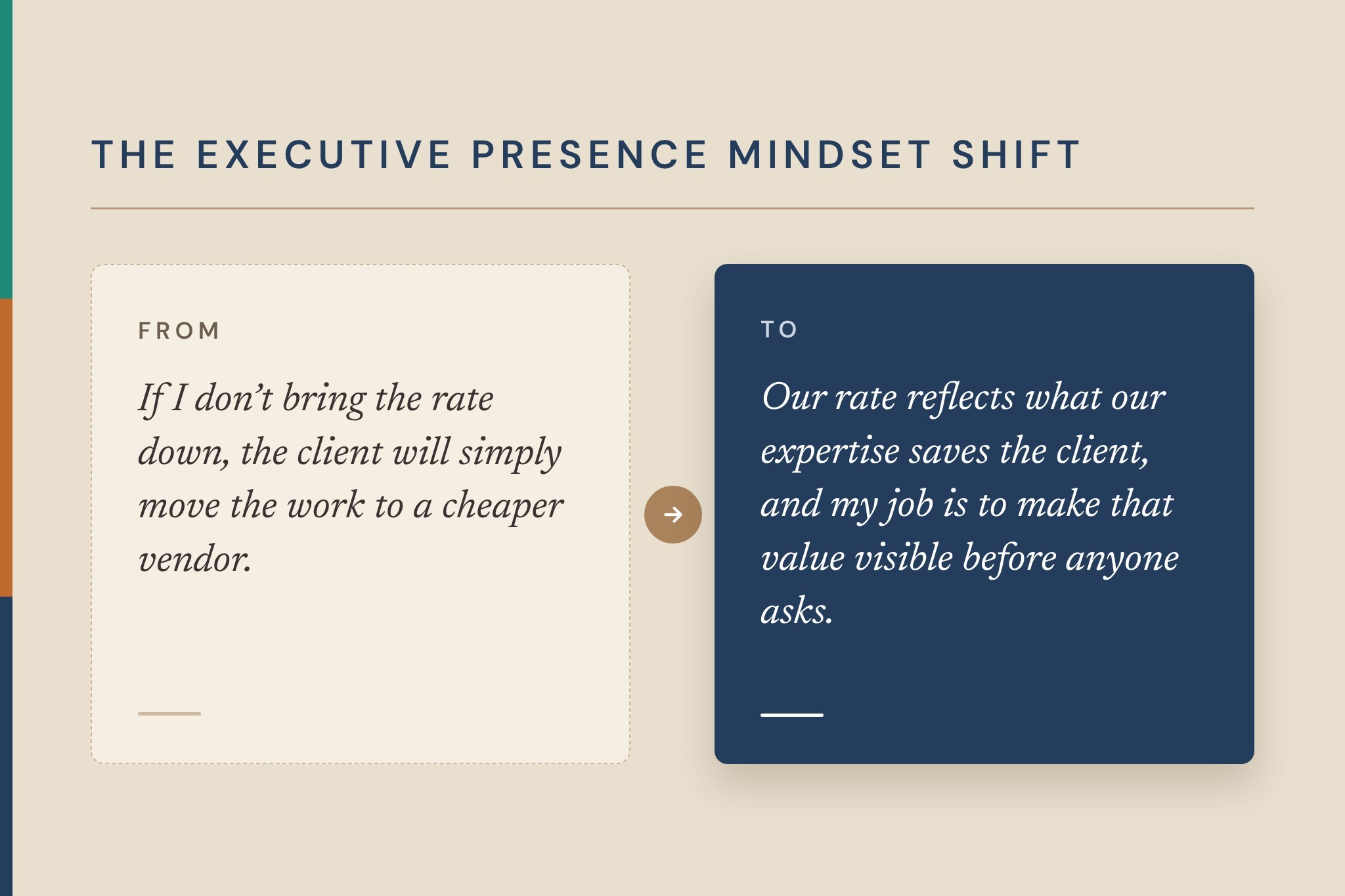

Renewal season has a familiar rhythm on most accounts, because procurement arrives with a benchmark, a reference to a cheaper vendor, and a request to bring the rates down by a percentage that feels carefully chosen. The delivery leader, who knows exactly how much the client depends on the team, still feels a strong pull to agree quickly and protect the relationship.
Giving in quickly feels safe, yet it sends a message the client hears very clearly, which is that the original rate was never really tied to anything in particular. Once a rate moves easily, the next negotiation starts from the new number, and the expertise your team brings becomes harder to describe because you have already accepted that it is worth less.
Positioning yourself as an expert to clients is what changes this conversation, because a client who understands what your experience prevents is weighing far more than a rate card. Research on how buyers judge quality supports this, since an integrative review of dozens of studies found a moderate but reliable link between price and perceived quality, which suggests that cutting a price can quietly cut the value people see (Rao and Monroe, 1989).
Explain What Your Expertise Prevents, Not What It Costs
Clients rarely see the incidents that never happened, the rework that was avoided, or the release that went live without disruption because someone experienced spotted a risk early. Your rates pay for exactly those outcomes, yet they stay invisible unless you describe them in the client’s own terms. Procurement teams are trained to compare rates, so if the comparison is all they have, the cheapest option will always look like the sensible one.
Before a rate conversation, gather three or four concrete examples from the past year where your team’s experience saved the client time, money, or embarrassment, and describe each one in a sentence. This is the most practical way of explaining the value of expertise, because it reframes the discussion around what the client would lose rather than what they are paying.
Change the Scope, Not the Value of Your People
When a client genuinely needs to reduce cost, it is far better to change what the team delivers than to discount the people delivering it. You might suggest phasing a workstream, adjusting the mix of roles, or moving routine work to a lower-cost model, while keeping your most experienced people where their judgment matters most. Clients usually respect a partner who protects the quality of the team, because they have often seen what happens when experienced people are replaced too quickly.
Asking whether there are any other options the client would consider, such as a longer commitment in exchange for a modest adjustment, keeps client rate negotiations creative rather than adversarial. It also shows the client that you take their constraints seriously, which makes your position on the value of your expertise far easier to accept.
Bring the Evidence Before Price Comes Up
The weakest moment to defend your rates is the moment procurement raises them, because by then the conversation has already been framed around cost. A short review of what your expertise delivered over the year, shared with your sponsor a few weeks before renewal, sets the context in which the commercial discussion will later take place.
That review can also include what you are seeing across similar programs and what the client might want to plan for next, which reminds them that your team brings judgment as well as capacity. When the rate conversation finally arrives, the client is already weighing it against a year of visible value, and your sponsor has something concrete to point to when their own leadership asks why the engagement costs what it does.
Holding a position calmly under pressure is a skill of its own, and it helps to know how to be more assertive at work without becoming defensive, so that your view on the rate is heard as considered rather than stubborn.
At Coach Vikram & Company, we would say that your delivery experience is your advantage in these conversations, because you can describe the value of your team’s expertise more precisely than anyone in procurement. Leaders who work with an executive presence coach often find that the rate was never the real issue, and that the client simply needed help seeing what the expertise was worth.