
.jpg)
A project has slipped, and the leader responsible is sitting in the review meeting while someone else walks through the numbers. From the outside, she looks fine. Inside, it's loud. They're all looking at me. I should have raised this last week. Are there any other options, or is this already decided? What do I say if they ask about the budget?
Nobody in the room can hear any of it. But it's taking up most of her attention, and when she's finally asked a question, she answers a slightly different one from the one that was asked.
Why Telling Yourself to Calm Down Rarely Works
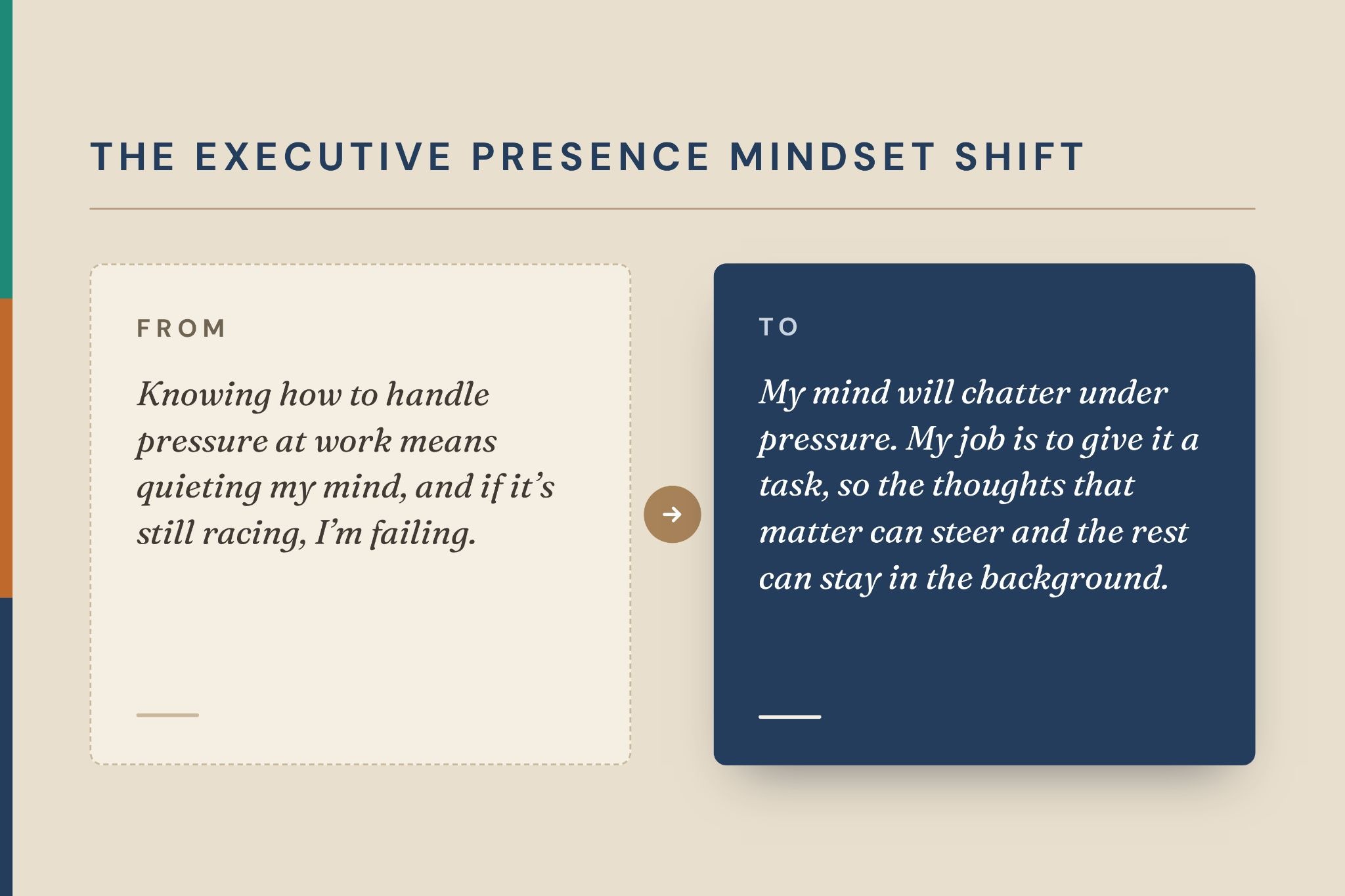
Most advice on how to handle pressure at work eventually comes back to some version of "stay calm." The difficulty is that calm is hard to order. Telling yourself to stop worrying tends to bring the worry straight back.
This is one of the better-documented quirks of the mind. In a well-known experiment, people asked not to think about a white bear for five minutes kept thinking about it, and afterward they thought about it more than people who had been allowed to think about it from the start (Wegner et al., 1987). Pushing a thought away seems to keep it close.
So the leader in the review meeting has a problem. Trying to silence the chatter makes it louder, and following it takes her out of the room.
Give the Mind a Job
There's a short video in which a Buddhist monk describes how to train what he calls the "monkey mind: the part of us that chatters constantly and offers an opinion on everything. He's clear that we can't block thought and emotion, and that we actually need them. Whether we follow every opinion the monkey mind offers is a separate matter.
His method is simple. You don't fight the monkey, and you can't bribe it, because as he puts it, giving it a banana doesn't work. You give it a job. "Watch the breath." Other thoughts will still come and go in the background, and that's fine. As long as you don't lose the breath, nothing else needs managing.
What makes this useful at work is his insistence that it doesn't take long. Two or three seconds count. One breath counts. He specifically mentions doing it in the middle of a meeting.
The breath is the most portable job, but the principle stretches further. Writing down the one question you need answered before you speak gives a restless mind something to hold. So does jotting down the next decision you actually have to make, rather than the ten that might follow it.
The approach works because it goes with the grain of the mind rather than against it. A restless mind wants something to do. Handed a small, concrete task, it tends to settle around it, and the commentary drops into the background instead of taking over.
Calm Is Not the Same as Quiet
It's easy to picture a calm leader as someone with nothing going on inside. That's rarely true, and it isn't the goal. The thoughts in the review meeting are partly useful. The budget question probably will come up. The trouble is when they all shout at once and nothing gets decided.
Staying calm under pressure is less about having fewer thoughts than about choosing which ones get to steer. A mind with a job has spare attention for the people in the room, which is most of what it takes to be more present as a leader when things are going wrong.
Pressure at work also isn't always a single moment. Sometimes it's a quarter of high-stakes moments strung together, and the chatter follows you home. The same method still applies. It just needs repeating more often.
A lot of executive presence coaching focuses on what calm looks like from the outside: a steady voice, an unhurried pace. What's happening inside gets less attention, even though it's what the outside is reacting to. At Coach Vikram & Company, we would say that the leaders who seem calmest in a crisis haven't silenced their minds. They've given them something useful to do.