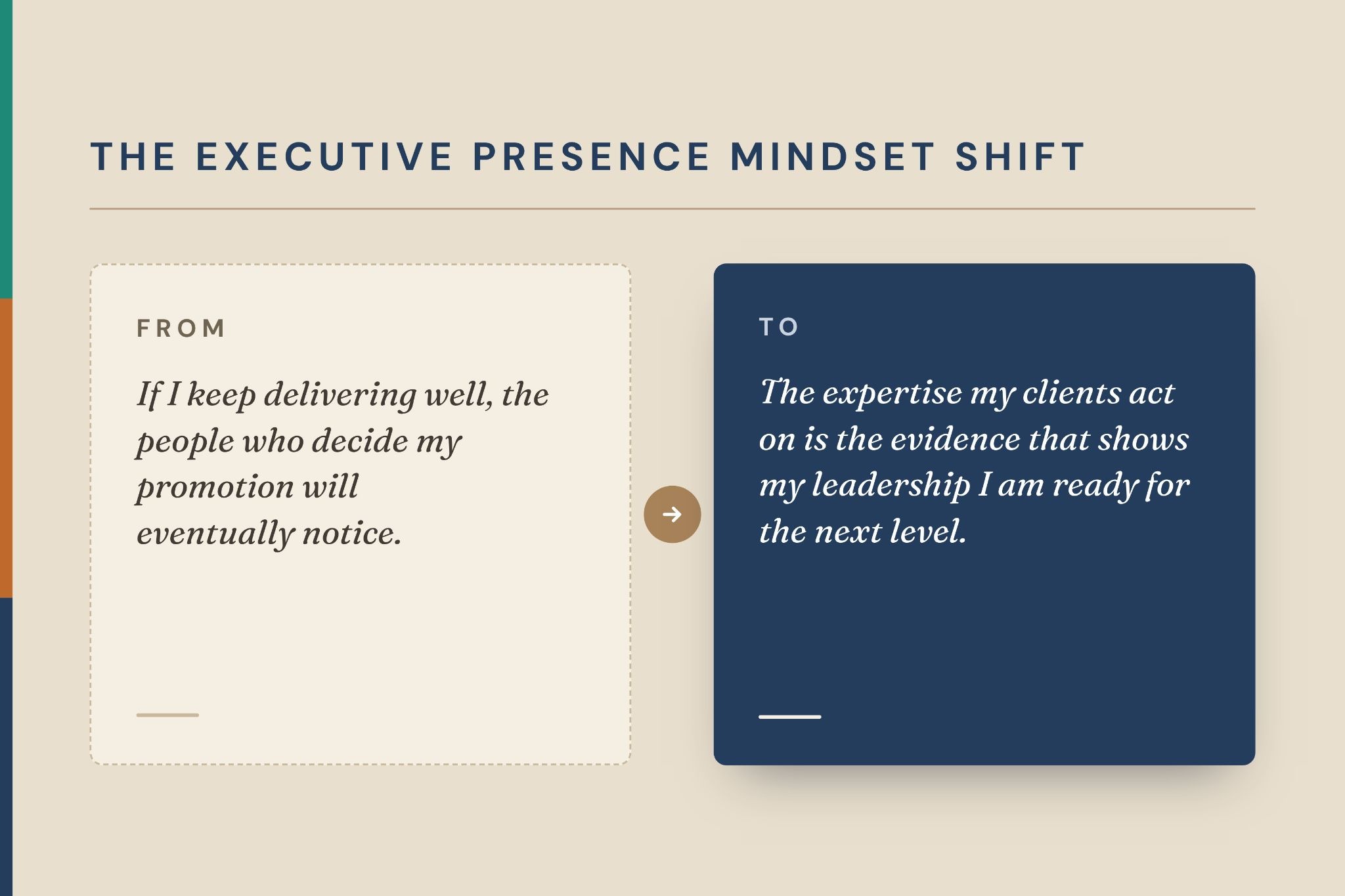

Many delivery leaders arrive at the edge of a VP role carrying the same quiet belief, which is that good work speaks for itself and the right people will eventually notice it. Then the promotion conversation comes around, and it turns out that the leaders who will decide it barely know you, while talking about your own wins still feels too much like bragging to do it with any conviction.
The difficulty is that a VP is rarely judged on how reliably they deliver, because by that level everyone delivers. What senior leaders are really looking for is evidence of judgment, meaning someone whose view clients actively seek, whose recommendations shape what the client does next, and who is treated as an expert rather than as a pair of capable hands.
That is why learning how to build credibility with clients is often the most direct route to being seen as VP material, since the strongest evidence of your judgment is a client acting on it, and that kind of evidence travels upward without you ever having to promote yourself. Research on career success supports this, because a two-year study of 180 employees found that people who put forward new ideas and better ways of working went on to receive more promotions and faster salary growth (Seibert, Kraimer and Crant, 2001).
Way One: Bring the Client a Recommendation Nobody Asked For
Most delivery leaders wait to be asked before offering a view, because answering the question in front of them feels safer than raising one the client has not considered. Yet a VP is expected to see around corners, and the clearest way to show that you can is to bring the client one well-reasoned recommendation they did not request, grounded in what your team has seen up close and offered as a question about whether there are any other options they have not yet weighed.
Making proactive recommendations to clients a regular habit also changes how the client describes you to others, because the person who brings ideas is remembered very differently from the person who simply executes them.
Way Two: Talk About Their Industry, Not Only Their Systems
The conversations you have with a client tend to stay inside the project, which keeps you firmly in the role of a technical expert on their systems. Clients at senior level, however, are thinking about their market, their competitors, and the regulation coming their way, and they notice very quickly which of their partners can join that conversation.
Sharing industry insights with clients does not require you to become an analyst, since a short observation about what you are seeing across similar programs, or a question about how a market shift will affect their plans, is enough to move you from order taker to advisor in the client’s mind.
Way Three: Let Your Expertise Travel Upward Through the Client
Once a client values your judgment, the most natural way for your own leadership to see it is through the client rather than through you. You might invite a senior leader from your side into a steering committee where you are leading the discussion, or ask a client who has acted on your advice whether they would mention it in their next review with your leadership.
This is the part that removes the discomfort of bragging, because when a client says that your recommendation saved them a quarter of rework, nobody hears it as self-promotion. The evidence speaks in the client’s voice, and it reaches exactly the people who will decide your promotion.
Most delivery leaders reading this are already working through calendars so crowded with internal reviews, handovers, and team meetings that there is little room left to think about a client’s industry, let alone to prepare a recommendation nobody asked for. If that sounds familiar, learning how to stop running on empty without slowing down is what creates the headroom this kind of thinking needs.
At Coach Vikram & Company, we would say that your delivery experience is your advantage here, because you have seen more of the client’s operation than almost anyone advising them. Leaders who come to executive presence coaching often discover that being seen as VP material depends less on how much they do and far more on how clearly their expertise shapes what clients decide, which is the kind of evidence a promotion conversation is waiting for.