Your Coach in Your Pocket

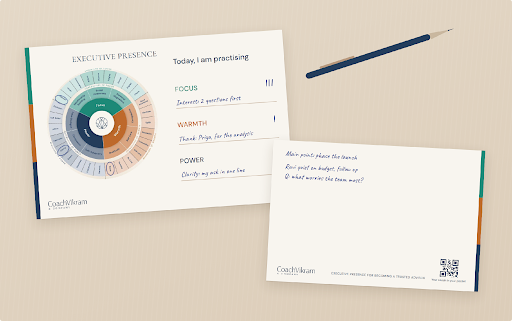
How to use your Executive Presence cue card to practise presence in the conversations that matter most.
This card is designed for the few minutes before an important conversation.
Most leaders prepare their content carefully: the numbers, the slides, the decision they need. Far fewer take a moment to prepare themselves. Yet how you show up shapes how your content is received, especially when the stakes are high.
The card helps with both. It lets you choose how you want to show up before the meeting, and notice how you are showing up while the conversation is still happening. That awareness is what allows you to bring your best version into the room
Meet your cue card
Your card has two sides. The model side holds all 27 behaviours of executive presence, arranged by the three styles: Focus,
Warmth and Power. This is where you choose what to practise.
The notes side is yours to use however the meeting needs.
Every card carries all three styles for a reason. Leaders with strong presence do not rely on one style. They balance Focus,
which builds likeability, Warmth, which earns trust, and Power, which establishes credibility.
.png)
1 The model: 27 behaviours, grouped by style and capability.
2 Today, I am practising: where you write the behaviours you choose.
3 One line for each style, with room at the end for tally marks.
4 The notes side: open space for whatever the meeting needs.
5 The QR code: your full guide, one scan away.
How to use it in three steps
1 Before the meeting
Take two minutes. Look at the wheel and choose one behaviour from each style. Write each one beside its style, followed by the action you will take. Keep the action small and specific, something you can do in the next hour.
2 During the meeting
Keep the card on the table. Each time you practise one of your three behaviours, add a tally mark beside that style. Use the notes side for anything worth capturing: your main point, what you notice in the room, or the names of people to thank.
3 After the meeting
Take one minute to look at your tallies. Which style did you practise most, and which least? Write one line on the notes side about what you will practise more next time.
The same card, before, during and after
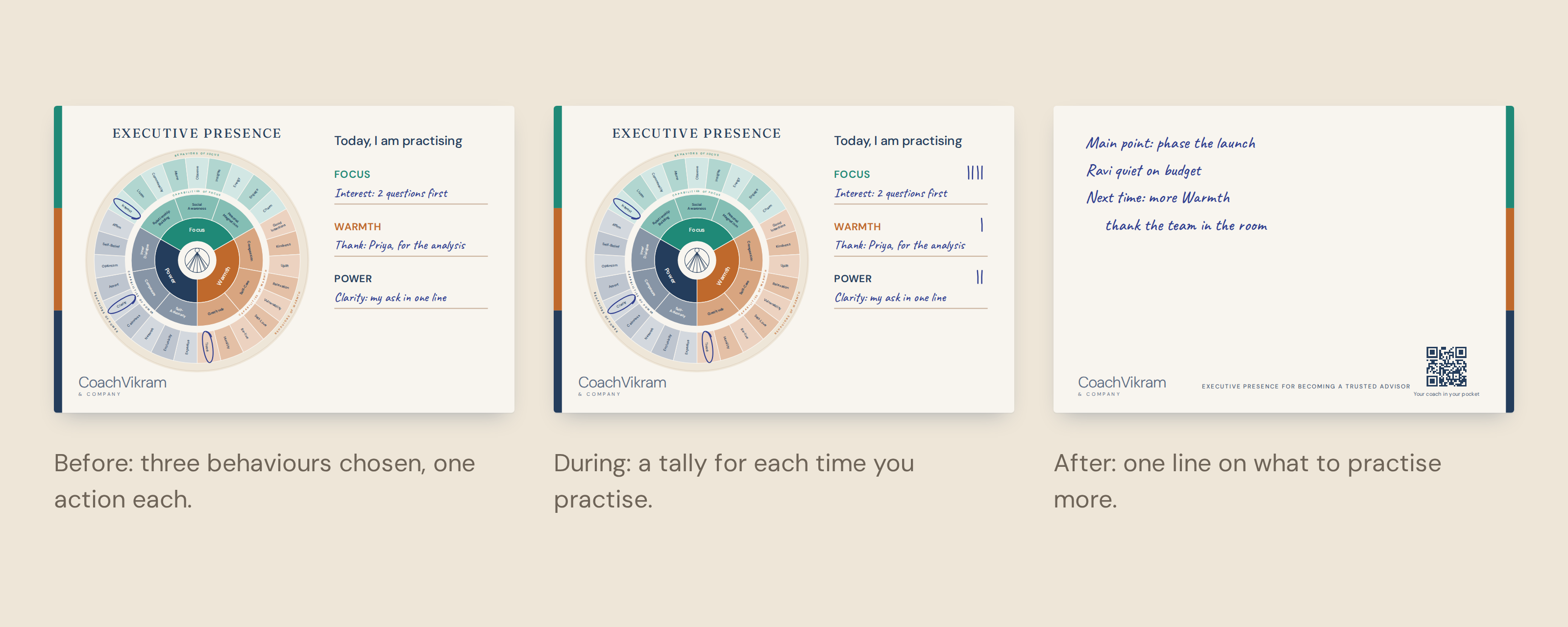
The tally marks are not a score. They simply show you what you practised more and what you practised less.
From behaviour to action
A behaviour name on its own is hard to practise. The card works best when you turn each behaviour into one clear action. Before you write, ask yourself: what would this look like in the meeting I am about to walk into?
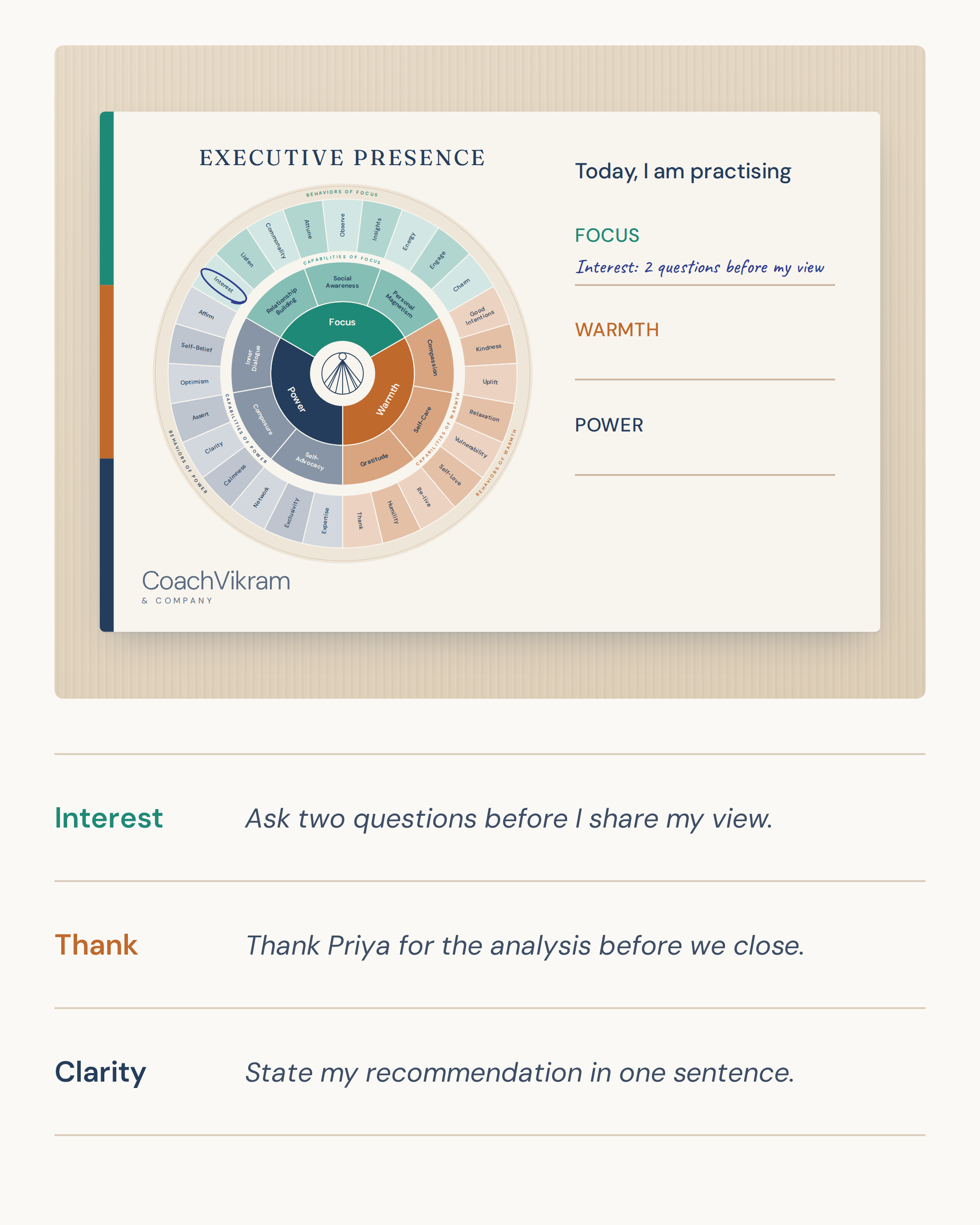
Good actions are small, visible and within your control. "Be more confident" is hard to act on. "Share my view in the first ten minutes" is something you can do today, and something you can count.