Executive Presence • Focus
The Name You Didn't Catch

Rajna Shetty

Most of us aren't bad at remembering names. We miss them in the two seconds they're said. A guide to how to remember names, and why it matters more than it seems.
You're introduced to someone at the start of an event. She shakes your hand and tells you her name. You say yours, mention where you work, and ask what brings her here. It's a perfectly good exchange. A minute or so later, a colleague walks over, and you realize, with a small cold feeling, that you're about to have to introduce her and you have no idea what she's called.
It didn't slip away. It was never really there.

Missed, Not Forgotten
Most people who say they're bad with names are describing something slightly different from a bad memory. The name arrived at the busiest moment of the conversation. Hands are moving, you're working out how firm a handshake to give, and above all you're getting ready to say something about yourself. The name was spoken while your attention was on your own introduction. It was never stored, so there was nothing to forget. Names don't fade so much as fall through the gaps in our attention, usually within seconds of being said.
That's worth sitting with, because it changes what fixing the problem looks like. Memory techniques help, and they come later. The first move is plainer: be fully there for the two seconds when the name is said. Let your own introduction wait.
If you didn't catch it, ask straight away, while asking is still easy. "Sorry, was that Aiko or Eiko?" costs nothing in the first thirty seconds. Ten minutes later, it costs a good deal more, and an hour later most people won't ask at all. They'll spend the evening carefully avoiding any sentence that needs the name in it.
Why Names Are So Slippery
Even names you do catch are oddly hard to keep, and there's a reason for it. On its own, a name means almost nothing. It doesn't connect to anything else you know about the person, so there's nothing for it to hold on to.
Psychologists have a neat way of showing this. When people learned names and occupations for a set of unfamiliar faces, they were more likely to recall that someone was a baker than that someone was called Baker (McWeeny et al., 1987). It's the same word. As a job, it came with a whole world attached: bread, early mornings, flour. As a surname, it was just a label.
That's the logic behind most memory hooks. You're trying to turn a label into something with a little meaning.
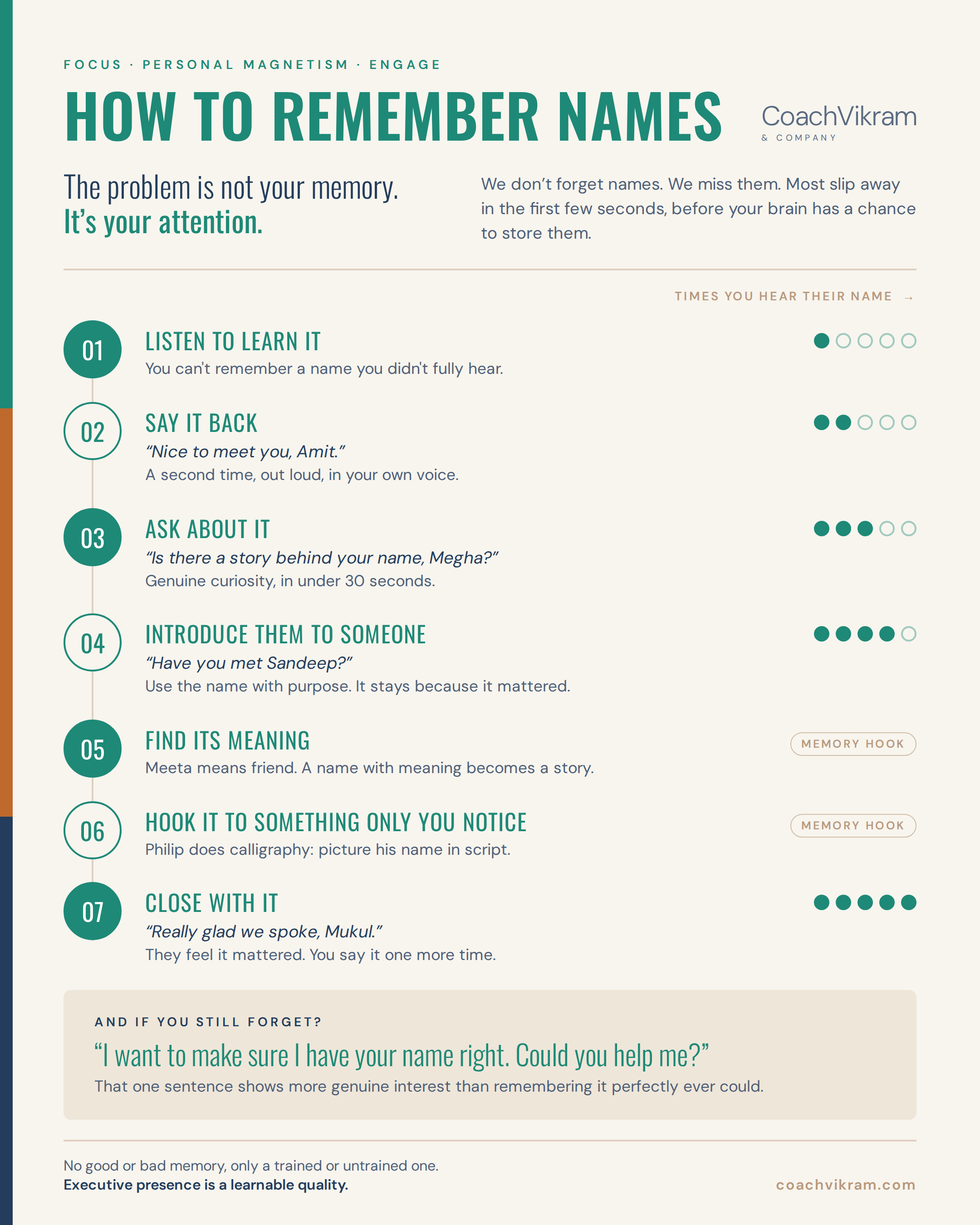
Sometimes the meaning is in the name itself. Plenty of names have a meaning in another language, or a story behind them, and asking about it is often welcome: "Is there a story behind your name?" It takes a few seconds, it tends to start a better conversation than "So, what do you do?", and you'll find the name much harder to lose afterward. It's worth reading the moment, though. People with unusual names can get tired of being asked, and a question that delights one person can feel like a chore to another.
Other times, the hook is something only you have noticed. A colleague mentions that he does calligraphy in his spare time, so you picture his name written out in ink. Someone tells you she has just moved from the coast, so her name goes next to the sea. These links don't need to make sense to anyone else. They only need to give the name somewhere to live.
Saying It Out Loud
The other half is use. A name heard once is fragile. A name you've said yourself, in your own voice, is a little sturdier.
The simplest version is to say it back when you meet: "Good to meet you, Daniel." Then use it again when it does something. Introducing him to someone else is the best opportunity there is. "Have you met Daniel? He's just joined the data team." You've used the name with a purpose, and the purpose helps it stick. When the conversation ends, close with it: "Really glad we talked, Daniel."
There's a version of this that goes wrong. Some people have picked up the advice to use a person's name as often as possible, and they put it into every second sentence. It sounds like a sales script, and people tend to notice. The name should appear when it would naturally appear, a handful of times at most. You're using it to remember it, not performing that you have.
When It's Gone Anyway
Everyone forgets sometimes, however good their habits. The real damage isn't the forgetting. It's the workaround: the months of "Hi there" and "Hey, you," the careful maneuvering to make someone else say it first, the slow awkwardness that builds up around a person whose name you've been pretending to know.
The way out is a single honest sentence: "I want to make sure I have your name right. Could you help me?" It's slightly uncomfortable for about three seconds. After that, it's usually a relief for both of you. Asking shows you care about getting it right, which is more than most people manage when they pretend.
Why It's Worth the Effort
For leaders, this can sound like a minor social skill, the kind of thing that's nice to have. It's more than that.
A name is one of the first things a person owns. When a senior leader remembers a new hire's name in a corridor three months after meeting them once, that new hire usually remembers it for a long time, and often tells other people. When someone's name gets mangled or forgotten repeatedly, the message they take away is rarely about memory. It's about who matters here.
It also tends to fall unevenly. The names most often forgotten are the ones attached to people at the edges of the conversation: the junior analyst, the person on the video call who rarely speaks, the new arrival from another office. Getting their names right is a small, very visible way of including them.
None of this is a trick to make people like you. Remembering someone's name is simply evidence that you were paying attention when they told you, and attention is what people respond to.
The infographic ends with a line that's worth a second look: there's no good or bad memory, only a trained or untrained one. That's probably a little too neat. Some people genuinely find names harder than others do. But almost everyone can get better at the two seconds that matter most, and that's where most names are kept or lost.
Rajna Shetty is an executive presence coach and creator of the Executive Presence Influence (EPI) Assessment at CoachVikram & Company. She specializes in measuring and developing leadership influence. Reach her at rajna@coachvikram.com