How Do You Build Stronger Professional Relationships?

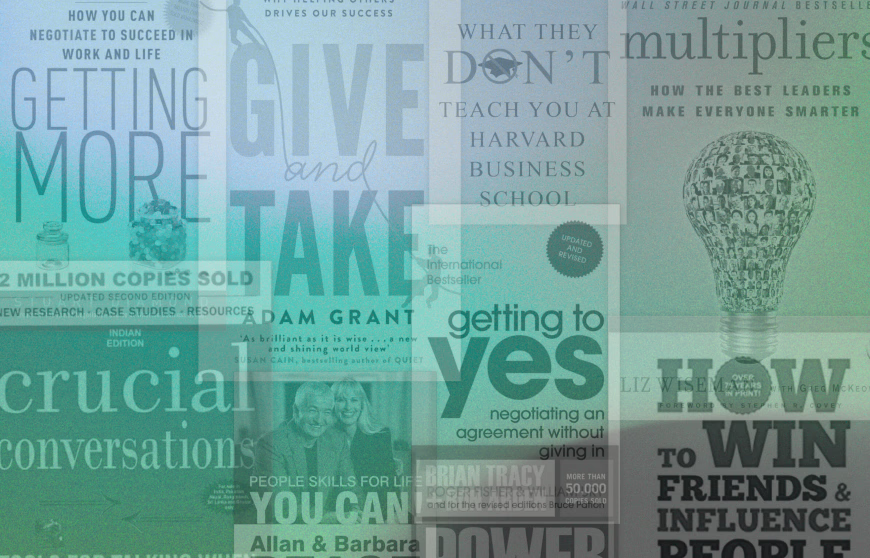
Relationship Building is the leadership capability that turns professional contacts into real allies. Three books that show you how.
A few years ago, I worked with a senior leader who was one of the most composed people in the room. In group settings she was measured and professional, showing up the way leaders often do when many people are watching.
In one-on-one conversations, she was different. She gave you her full attention. She asked real questions. After important conversations at the senior level, she would take me through what had been discussed, not just the strategic objectives, but how the team was expected to show up as leaders. That access changed the way I worked. I stopped thinking only about hitting our goals. I started thinking about how to help her show up powerfully in the rooms that mattered most to her.
Looking back, what made that relationship possible was one thing: commonality. We were constantly finding the things we shared, about our cultures, our families, the paths that brought us to where we were. That shared ground is what made everything else possible.
That experience is the clearest example I know of what Relationship Building looks like when it works.
What Relationship Building really is
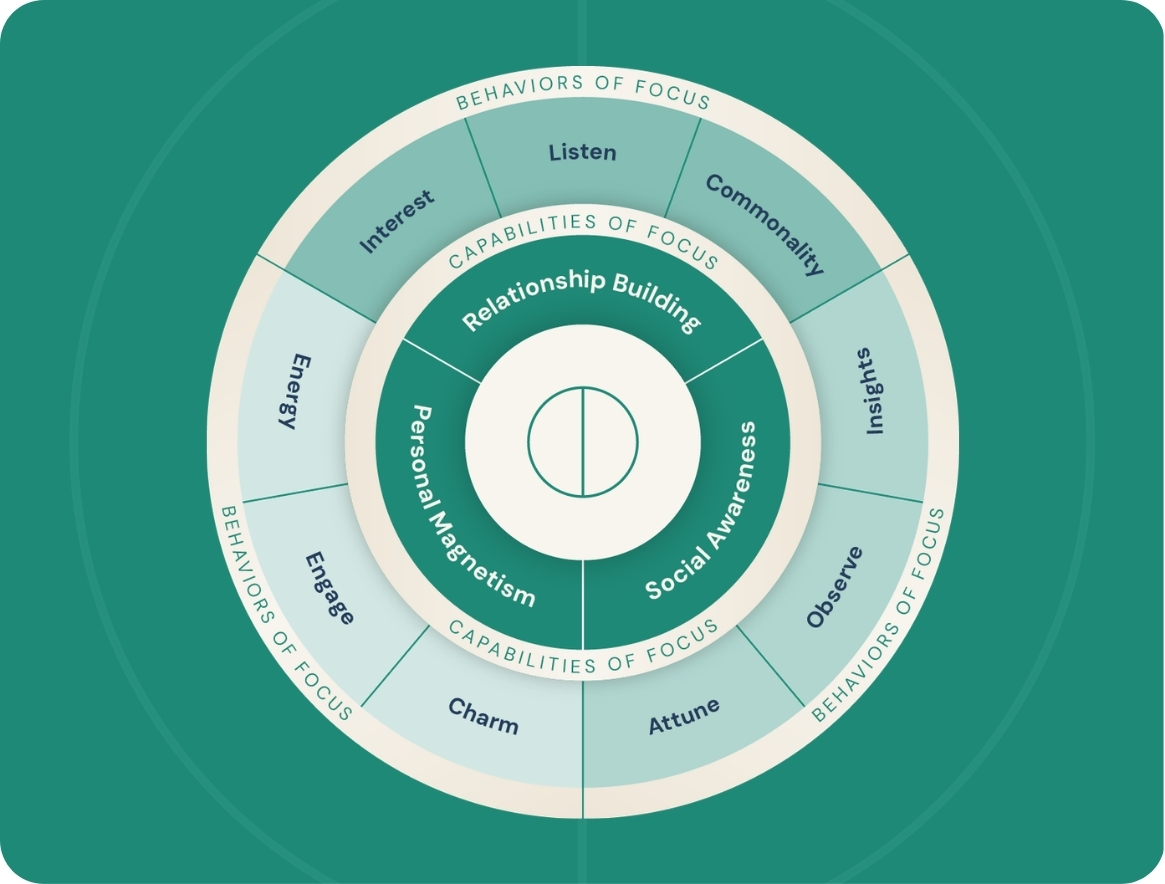
In the Focus style of executive presence, Relationship Building is one of three core capabilities. It is the practice of cultivating meaningful professional bonds by learning what drives the people around you and finding shared ground to work together effectively.
It is worth separating this from two things it is often confused with. The first is networking. Networking is transactional. You meet people, exchange information, follow up. Relationship Building is what happens after that. It is the long game.
The second is rapport. In executive presence coaching, we share that Focus helps you connect and build rapport quickly. Relationship Building is different. It is not what happens in the first five minutes. It is what accumulates over months and years of genuine interest, active listening, and finding commonality. You can have good rapport with someone you barely know. A real professional relationship takes time.
So why do so few people invest in it? Often it is not a lack of interest. It is a mistaken assumption that the other person does not want the connection.
Research by University of Chicago Booth School of Business professor Nicholas Epley finds that people consistently underestimate how much others want to connect. His research published in the Journal of Experimental Psychology shows that assumption is wrong across many different settings. The barrier to Relationship Building is rarely the other person. It is our own hesitation.
In our work with senior leaders, the ones who reach trusted advisor status are almost always the ones who have invested in relationships at this level. Not because they are naturally warm or outgoing, but because they have made it a practice.
Where this skill matters most
Relationship Building is relevant in any leadership context. But there are specific situations where it becomes the deciding factor.
In sales, the person who understands what the other side actually needs closes more than the person with the best pitch. When we work with clients in our executive presence training for sales leaders, we consistently find that the gap between good performers and top performers is not product knowledge or technique. It is the quality of their professional relationships. The best sales leaders are not selling. They are partnering.
In movement building and advocacy work, people follow leaders who make them feel seen. You cannot build a coalition through logic alone. You build it through the relationships that make people want to stay close to your work.
In organizational leadership, the cross-functional partnerships that drive the most important outcomes are built on this same foundation. The leaders who can move resources, align stakeholders, and get things done across organizational boundaries are almost always the ones who have invested in relationships before they needed anything.
Three books that develop this capability
In executive presence, Relationship Building is the capability that matters most when your success depends on other people choosing to work with you. These are the three books I return to for developing it deliberately.

Stuart Diamond spent decades teaching negotiation at Wharton. His core argument is that the key to getting what you want in any interaction is not leverage or logic. It is understanding what the other person values and finding a way to connect your goals to theirs.
For Relationship Building, the most useful idea in this book is that every person you interact with has a different set of pictures in their head - their expectations, their priorities, their definition of a good outcome. Your job is to find out what those pictures look like before you start talking about your own.

Adam Grant divides people into three categories based on how they approach relationships: givers, takers, and matchers. His research shows that the most successful people over the long term tend to be givers, people who contribute to others without keeping score.
What makes this relevant to Relationship Building is the distinction Grant draws between strategic giving and genuine giving. The leaders who build the deepest professional bonds are not the ones who give because they expect something back (transactional). They give because they are genuinely interested in the other person succeeding (relational).
Before your next stakeholder meeting, ask yourself what you could bring to that person that has nothing to do with your own agenda. Not as a tactic. As a practice.

Liz Wiseman studied leaders who make the people around them more capable versus those who, often unintentionally, diminish them. The distinction she draws has a direct connection to Relationship Building: the leaders who build the strongest professional bonds are the ones who make others feel more intelligent and capable in their presence.
This connects to the commonality insight from my own story. When my colleague found the things we shared, it was not just warmth. It was a signal that she saw me as a full person, not just as someone with a role to fill. That is what Multipliers do. They expand how people see themselves.
If you want people to invest in a relationship with you, start by investing in how they see their own potential.
Taking Interest is what makes relationships grow
All three books come back to the same underlying skill: Taking Interest. Not curiosity as an internal state, you can be curious about someone and never show it. Taking Interest is the active, visible expression of that curiosity. It is asking the question. It is following up on what someone shared last time. It is finding the commonality and naming it out loud.
That distinction matters because executive presence is always behavioral. What your stakeholders experience is not what you feel on the inside. It is what you do.
If you want to understand where your own Relationship Building behaviors stand right now, the Executive Presence Influence Assessment measures all 27 behaviors across Focus, Warmth, and Power and gives you a personalized report you can act on immediately.
Aquiles Damirón-Alcántara is an executive presence coach at CoachVikram & Company. He designs the curriculum and learning experience behind our programs, ensuring every session drives real transformation in how leaders influence high-stakes moments. Reach him at aquiles@coachvikram.com